
“CATsters Caught Reading.” Art installation. City Arts and Technology, San Francisco. via Instagram: http://j.mp/1ldQ1lH
“CATsters Caught Reading.” Art installation. City Arts and Technology, San Francisco. via Instagram: http://j.mp/1ldQ1lH
 Here are the classroom rules of an exceptional ninth grade English teacher at Envision Academy in Oakland, California.

My favorite is #3. Which is your favorite?
 Nikole Hannah-Jones is my new hero. She’s the author of “Segregation Now,” the ProPublica and Atlantic Monthly piece (that you must read!) about the resegregation of schools in Tuscaloosa, Alabama.
Here she is in an interview on Democracy Now. She connects her recent article with this week’s Supreme Court case, Schuette v. BAMN, which allowed Michigan voters to amend their state constitution to disallow race as a factor in college admission.
Here’s a quote that resonated with me:
I think it’s very obvious, if you just look just strictly at the facts, that we still have a racialized K-12 system, and that Black and Brown students tend to be in schools where they are receiving an inferior education. They have a less-rigorous curriculum. They’re less likely to get access to classes that will help them in college, such as Advanced Placement Physics, higher-level Math, and they are most likely to be taught by inexperienced teachers.
Later in the interview, when discussing Brown v. Board of Education, Ms. Hannah-Jones says, “Resources follow white students in this country….Today that’s still the case. We have not eliminated that connection between resources and race.”
Ms. Hannah-Jones knows what she’s talking about. Like Michelle Alexander, author of The New Jim Crow, Ms. Hannah-Jones deserves to be heard.
 Now that generous contributors have donated more than 150 Kindles to the Kindle Classroom Project, it’s time for a real, grown-up, scientific study about the effects of using Kindles on student reading identity and achievement.
I’m excited.
I’d like the study to answer the following questions:
1. Do students who read on Kindles (aka Kindlers) read more than their peers who read physical books (aka non-Kindlers)?
2. Do the reading skills of Kindlers grow more than those of non-Kindlers?
3. Do the Kindlers grow to like reading more? Do they identify as readers more than the non-Kindlers?
4. For which students is the Kindle most and least effective? This could include race, gender, reading skill, or other characteristics.
5. Which Kindle configuration is most effective — mandatory-for-all, student opt-in, or by-teacher-invite?
OK, that’s a lot of questions, and I’ve never done a scientific-ish study, so this is where maybe you could help out! The good news is, I have a lot of resources ready to go. For example, I have 150 Kindles, several interested teachers, a high-quality online reading assessment, and a well-regarded reader identity survey. Those things are in place.
What’s not in place is exactly how to set up the study. Ideally, for a number of reasons, I’d like to work with just one teacher, preferably who teachers ninth graders.
But I’m not sure all of my questions can be answered with just one teacher and just 100 students. To be specific: Questions #1-3 (actually, maybe Question #4, too) deal with whether Kindlers do better than non-Kindlers. It seems to me that 1/2 of the students should be reading on Kindles while 1/2 should be reading physical books. Isn’t that right? If so, Does that mean that two classes should have Kindles throughout the year and the other two not get access to them? Or should we switch in the middle, just to see if the same students behave differently with- or without a Kindle?
Another concern: What should I do with question #5? It seems important to investigate whether there is a difference if students get to opt into the program vs. if they’re invited by a teacher or required by a teacher. Would reading growth go down if students feel forced to use a Kindle? Though I like these questions, I’m not sure how to pull off this part of the study at the same time as the Kindle vs. non-Kindle part. What are your thoughts?
Let me say again: I’d love to hear your ideas about how to set this up. Though I went to grad school (really, I did!), I’ve never taken a methods class. Let me know your thoughts. You can leave them in the comments or email me at mark (at) iserotope (dot) com. All help is appreciated. Thank you!
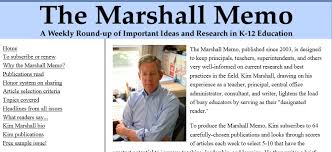 I wasn’t having a great Monday until an email from Kim Marshall arrived in my inbox.
Yes, the Kim Marshall, of The Marshall Memo, the extremely well-regarded weekly publication that curates and summarizes key articles about K-12 education.
Here is the email in part:
I enjoyed your article in Phi Delta Kappan and summarized it in this week’s Marshall Memo, a newsletter I send to subscribers in the U.S. and around the world (attached). I hope you feel I did justice to your piece.
Wow! Mr. Marshall enjoyed my article about the Kindle Classroom Project? And he liked it enough to include it in his newsletter — out of the 100+ articles he reads every week from the 64 journals he reviews?
I’m very honored. (Mr. Marshall, of course you did justice to my piece. Thank you.)
Here’s the Table of Contents. Seven is a great number.
 Also, I must say this: I am very impressed by Mr. Marshall’s work. Content curation is not a new buzzword to him. He’s been reading about education and publishing his Memo since 2003. (On a side note: I wish I’d come up with this great idea!)