Back from summer vacation, ready for the new school year

favicon Hi again! I hope all of you had a great summer and are ready for the new school year. I am! It’s been a busy summer. But it’s also been fun to relax and recharge.

Let me catch you up.

The biggest news is that my partner and I moved from San Francisco to New York. After spending my entire life in the Bay Area (except for a year in graduate school and several summers in other cities), I wanted to try out a new adventure. It’s a little crazy — and some of my friends and family have made sure I know this — but so far, I’m feeling great feeling stretched.

Unfortunately, the move meant having to leave the great job I had last year as an instructional coach. Though I don’t reveal my employers on this site (to honor their policies regarding technology use), I can say that it was tough to leave the teachers with whom I worked. Together we made significant progress in figuring out what it means to teach high school students how to approach reading in a new, joyful, visible way.

NewYork

The good news is, I was able to find a new job here in New York that is extremely similar. Instead of working at four schools, however, I will work exclusively with teachers at one school in the Bronx. Along with another instructional coach, my role is to promote the teaching of literacy across the curriculum and to help develop teachers’ confidence in teaching specific reading strategies.

The only major difference (as I see it, though this might change) is that I’ll likely be working with more beginning and inexperienced teachers than I did last year. My preference, of course, is to work with veteran teachers (for many reasons). It’s more easily and immediately fun. Yes, that’s selfish. Nevertheless, I also understand how crucial it is for teachers to receive high-quality coaching at the beginning of their careers. I remember my mentors in Cambridge and Fremont, and I hope to return the support and inspiration I received.

The weird part is, I always have trouble starting at a new job. Maybe that’s one reason I stuck around my San Francisco school for 12 years. (There are many other reasons, too!) It’s hard for me to get to know people; they probably feel the same thing about me. Doubts creep up: Um, do I really know anything about literacy, anyway? Where’s my credential? What makes me think that the teachers will find me helpful? I’m no expert, after all.

But over time, I trust, things will smooth out and take care of themselves.

Sort of rambling here, but I’ll leave you with one last thing (and go into more depth in an upcoming post). The Kindle Classroom Project has seen steady growth over the summer, and I’m happy to report that I’ll be receiving the 70th Kindle in the next few days!

All of the Kindles safely made the transcontinental move, and I’m eager to get them ready for the new students. Why didn’t the Kindles stay in San Francisco and Oakland? After tons of thought, I decided the program would be stronger if I’m nearby. Keeping all the Kindles up and running — not to mention the ebook library — takes constant care, and troubleshooting across the country just didn’t sound right. I look forward to meeting with the ninth grade teachers at my new school to get them hugely excited about getting their students involved.

I am also very happy that some of my passion for reading will not leave the Bay Area. My friend and former colleague Nancy Jo Turner, who works in Berkeley and is an excellent! excellent! ninth grade teacher, has agreed to take care of my physical book library and to launch a significant independent reading program with her students. She just completed cataloging the books — there are 512 in total! I can’t wait to share her updates from her classroom.

Update: I’ve decided to move back to San Francisco. More details in a future post.

So there it is, a rough update about what’s been going on this summer. I look forward to hearing from you, loyal Iserotope readers, and to share with you more stories this year. Let me know what you’d like to read about! favicon

5 things I learned as an instructional coach this year

favicon Some of you may know that I was an instructional coach this year. After 15 years in the classroom teaching students, I focused this year on helping teachers improve their literacy instruction. It was a lot of fun, and I learned a lot. Here are some highlights:

1. Coaching is infinitely easier than teaching.
Coaching is predictable, while teaching is not. The introvert in me prefers stability over chaos, and while coaching certainly isn’t as scintillating as teaching, it’s undeniably easier. There are no papers to grade, no lessons to plan, no late nights, and no early mornings. My stress level plummeted, and as a result, my energy was almost always high (which made me better at my job).

As a coach, I probably worked 30 percent as hard as I did as a teacher. We all know that teaching is a challenging job, but until you’ve done it and then not done it, it’s impossible to tell. Compared with teaching, my full-time job as an instructional coach seemed like a fully paid sabbatical.

2. It’s not easy to be a good coach.
Even though coaching is much easier than teaching, that doesn’t mean being a good coach is particularly easy. There’s a fine line that coaches must balance — between being an expert and being an colleague. Some coaches, perhaps in attempt to legitimize their position, present themselves as too “knowing,” too much like an expert. This is the wrong approach. It does not honor teachers or teaching.

But the flip side is also problematic. If you’re too much of a “friend” — and if you hide your experience and your years of struggle (and epiphany) — then you’re not appropriately serving as a coach, either. The teachers I worked with reported that I mixed wisdom (maybe my graying hair?) with collegiality — and that humor also didn’t hurt. Most important, I learned that establishing rapport is by far the most crucial step in building a strong working relationship.

3. I’m pretty good at coaching.
It helped that I had a great boss who helped me hone my skills and an excellent coach colleague that I bantered with every day. But what I learned is that while I still struggle with large professional development sessions (facilitating a group of 10+ teachers is not easy for me), I’m pretty good at seeing teachers as they improve their practice.

One thing I did at the beginning of the year was observe each teacher for an entire period. Apparently, this wasn’t standard practice. In the back of the classroom, I took informal notes, and nearly all of the teachers told me that they expected me to stick around for just part of the period before moving on. This little (and easy) gesture built trust quickly and easily.

4. Coaching makes me a better teacher.
When you’re a teacher, you rarely get to observe other teachers. All you know about your colleagues is what they report and what students say. What happens in the classroom, then, is filtered through the eyes of others. (That’s partly why more teachers are filming themselves now.)

As a coach, I get to see good teaching and learning every day. I get to talk with students about what’s effective, about the best ways they learn. I get to talk with teachers about what excites and sustains them. And I get to advocate for strong literacy instruction every day. Nobody thinks I’m a crazy person when I champion the importance of reading. It’s my job.

5. I miss teaching.
Yes, coaching is easier, and it means my nights and weekends are free, but it’s not as fulfilling or exciting as teaching. There’s a once-removed piece to the real work of supporting students to reach their goals and dreams. Teaching was always a struggle for me. I had as many failures as successes. But as cliche as this sounds, there’s nothing more important.

For the time being, I’m sticking with coaching, maybe for a couple or few more years. It’s entirely possible that I’ll get too used to the ease of coaching and not return to the classroom. But I hope not. It’ll be better, I think, to figure out how I can forge a new chapter of teaching that is good for both me and my students. favicon

4 Kindles in just 1 day!

favicon The Kindles come in waves.

That’s what happened today. After more than three weeks with no new donations, four new Kindles arrived today!

It’s bizarre, and it’s hard to explain, but I’m very excited and appreciative.

Take a look at the four boxes all stacked up!

4 new Kindles boxes

As everyone knows, shipping isn’t cheap. Donors always pack their Kindles with great care. Because most contributors pay for their own shipping, that means I can focus on buying new books for students.

Here are the four new Kindles! Please notice the handsome cases.

4 new Kindles

Here’s more evidence of the care that donors demonstrate. See how each case is different? The cases I buy are functional, strong, and cheap. They’re perfectly fine. But they lack the creativity and class that these cases have.

Speaking of creativity, check out this Kindle!

Colorful Kindle

See how much personality? For many people, a bright and colorful skin won’t affect their reading habits too much. I’m one of them. But I can guarantee that the student who receives this Kindle will cherish it and make it her own.

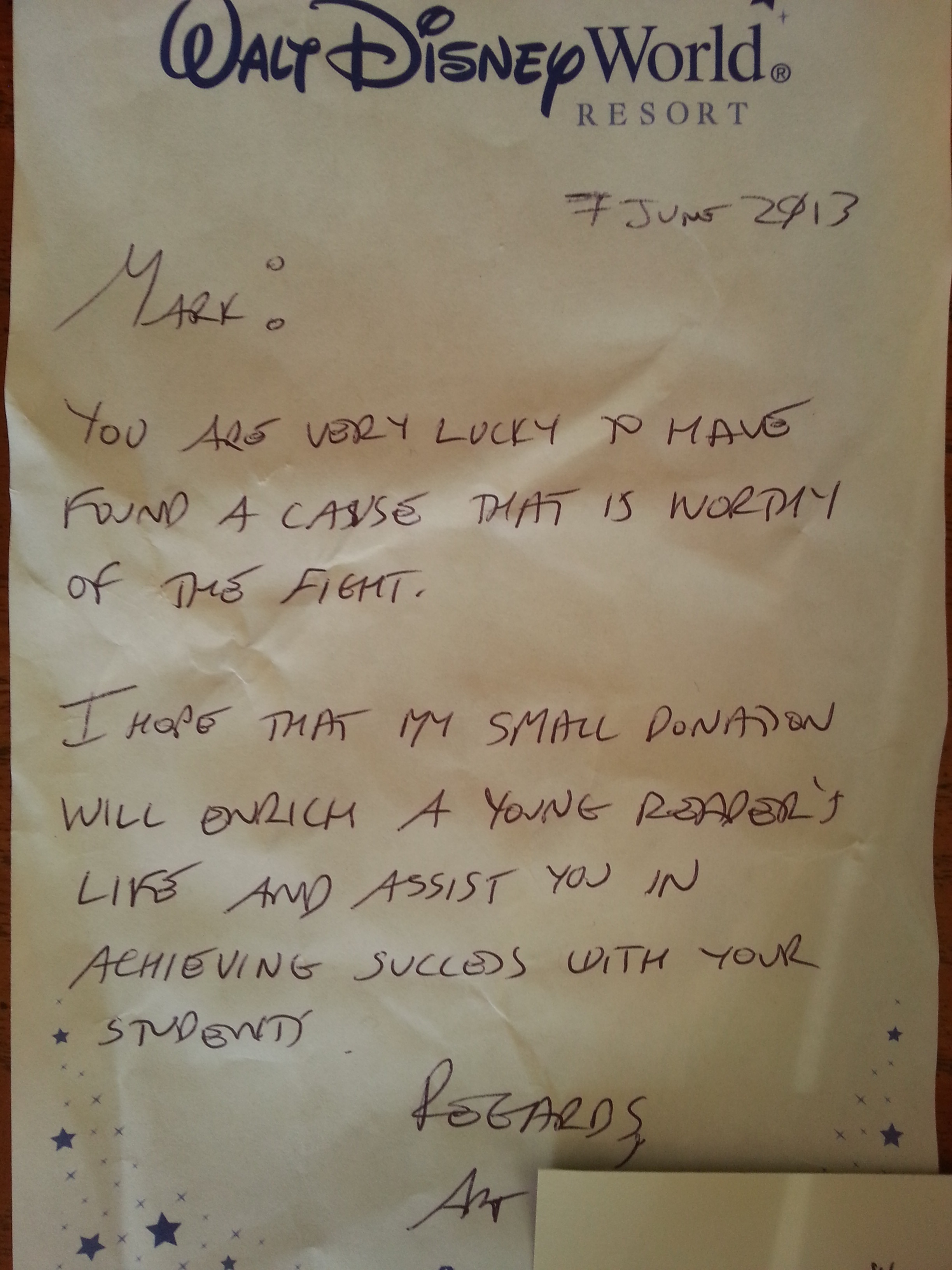
In addition to the Kindles, I receive kind notes. Here’s one from today:

Arts Note

All of this generosity of spirit continues to inspire me.

Let’s be clear: Here are people from across the country who don’t know me, who find out about the Kindle Classroom Project over the Internet, who choose to donate their Kindle to a perfect stranger, who package and ship their Kindle carefully, who throw in their colorful protective case, and who write me an inspirational note.

It’s pretty great.

So with a ton of enthusiasm and gratitude, I’d like to thank Anja from San Francisco; Thomas from Chicago; Angie from Roanoke, Virginia; and Art from Redding, Connecticut.

You’ve made this day a special one for me, the KCP, and for four rising ninth graders who don’t yet realize they’re just a few months away from a reading adventure. favicon

Measuring reading growth: Not just test scores

favicon In our data-driven society, no matter where you go, everyone cares about the same thing: results. If you can’t quantify your gains, then too bad for you.

The same goes for reading instruction. It’s the end of the year, and I’ve been thinking a lot about results. Have my efforts made a difference? Are my students better readers than there were back in September? And if they are, how do we know?

Let’s get one thing out of the way: Tests matter most. Therefore, I’m relieved that students performed well on our online reading assessment, and I’m particularly pleased that Kindlers improved more than non-Kindlers.

But tests are just tests. They don’t paint the whole picture.

That’s why I believe that several measurements are necessary to assess student progress in reading. This year, we’ve tried these data points:

  • How many books / pages the students have read,
  • Reading stamina
  • Reading fluency
  • Whether students say they enjoy reading,
  • Whether students identify as readers,
  • How well students can independently use the reading strategies we’ve taught.

My goal next year is streamline this list down to 2-4 key indicators. That way, all teachers and students can track their progress on common, agreed-on criteria.

Which data points do you think are the most important? Or, do you suggest others? favicon

Kindle Classroom Project update, June 2013

favicon It was a relatively slow month at the Kindle Classroom Project. But there are still plenty of things to celebrate, and here are a few highlights.

1. The Project received its first Kindle donation via Craigslist.
Back in November, I began scouring Craigslist for people who might want to donate their Kindles. So I set up an alert to my Google Reader, and whenever someone in San Francisco posted a Kindle, I wrote a quick email.

Today, 100+ email requests later, Alex from San Francisco responded, and in typical Craigslist fashion, we met up at a local cafe, where we made the trade. Except I didn’t give him anything besides my thanks. Alex said that he decided to donate his Kindle Touch after prospective buyers flaked. Thank you, flaky Craigslisters! And thank you, Alex.

2. We’re now up to 50 Kindles.
Thanks to Janie (Vashon, WA), Jenni (Berkeley, CA), an anonymous international donor, and Alex (San Francisco, CA), the Project added four Kindles this month. I’m very pleased.

I’d like to keep up the momentum. At this rate — an average of 1 Kindle donated per week — it’s possible to reach my goal of 60 Kindles by September 1.

3. There’s still good progress on e-books.
This month, 18 books were donated, making the total 265. I’d like to thank LeAnne from Fremont for her donation of three books. My goal of 300 books by September 1 seems reachable.

Among the new titles: The New Jim CrowSleeping With the EnemyTravel TeamSummer Ball, and Drama High. I’m finding out that many ninth grade boys like novels about sports. Many ninth grade girls appreciate that their teacher is not censoring Drama High (this generation’s version of Sweet Valley High).

4. It was a huge month for money donations.
DonorsChoose celebrated Teacher Appreciation Day by offering a promotion: double your donation. In just one day, I received almost $1,300. Thank you DSW, Bernice, Michele, Iris, Stuart, Laura, and LeAnne! I’m saving up the money for a big project next year!

* * *
What will June bring? Will people keep hold of their Kindles in preparation for summer reading? Or will they flock to the beach with their physical books and want a better home for the e-readers?

I’m looking forward to celebrating this year’s work and the 49 students who have read a lot. I can’t wait to reflect and figure out next year’s goals. Thank you again to everyone who has made this year a huge success at the Kindle Classroom Project! favicon

Enhanced by Zemanta