Research on e-readers in schools (#1)

research-paperfavicon Recently I rediscovered the excellent electronic databases at the San Francisco Public Library, which means I can get access to JSTOR and do other nerdy things.

(Not unrelated: I’m working on getting a library card from the Library at UC Berkeley. Can’t wait.)

Anyway, I got searching on JSTOR, and there are tons and tons of articles about e-readers and their effects in students, so I figured I should read some and tell you about them, because hey, the Kindle Classroom Project is working for a reason, right?

So here’s the first installment in a sometimes-series that I’m going to call “Research on E-Readers in Schools.”

E-Readers: Powering Up for Engagement
By Twyla Miranda, Kary A. Johnson and Dara Rossi-Williams
Educational Leadership, June 2012

The authors conducted a study of 199 middle school students in an urban public school in the Dallas-Forth Worth area. They found that students, especially boys, had more motivation to read during the school’s Sustained Silent Reading period if they had the opportunity to choose an e-reader in addition to physical books.

It’s not a surprise that the researchers noted that boys found e-readers exciting. I see the same thing, anecdotally, with my students. Latino boys in particular — especially those who are significantly below grade level — like reading on Kindles. It’s as if the Kindle gives them another chance to get excited about reading again.

The authors did not go into any specifics about whether e-readers helped improve students’ reading skills. My preliminary (but unscientific!) research suggests that it does. Kindlers in Oakland last year rose 1.9 grade levels, 73 percent more than their non-Kindler peers. This year, the effect is similar: Kindlers have grown 75 percent more.

(Naturally, I recognize my data’s limitations. There are many. But it’s clear that something special is happening with students who read on Kindles.)

Finally, the note many benefits to using e-readers to promote reading. All but one are very similar to those I’ve experienced. For example, students in the study reported that there is no gap between finishing one book and starting another. The e-reader allows different font sizes, and some students liked using text-to-speech. My students say the same thing.

The only difference is that the middle schoolers in Dallas-Fort Worth also liked highlighting and annotating their books. I haven’t seen my students do much of that, though they do like making their own collections. It might be a good idea to introduce my students to that feature (along with others) in our monthly Kindle meetings.

Next up, I’ll try to find some articles that have some hard research on whether Kindle help raise reading scores. Do you think it’s out there? favicon
Parents, force your kids to read 20 minutes a night…or else bad things will happen

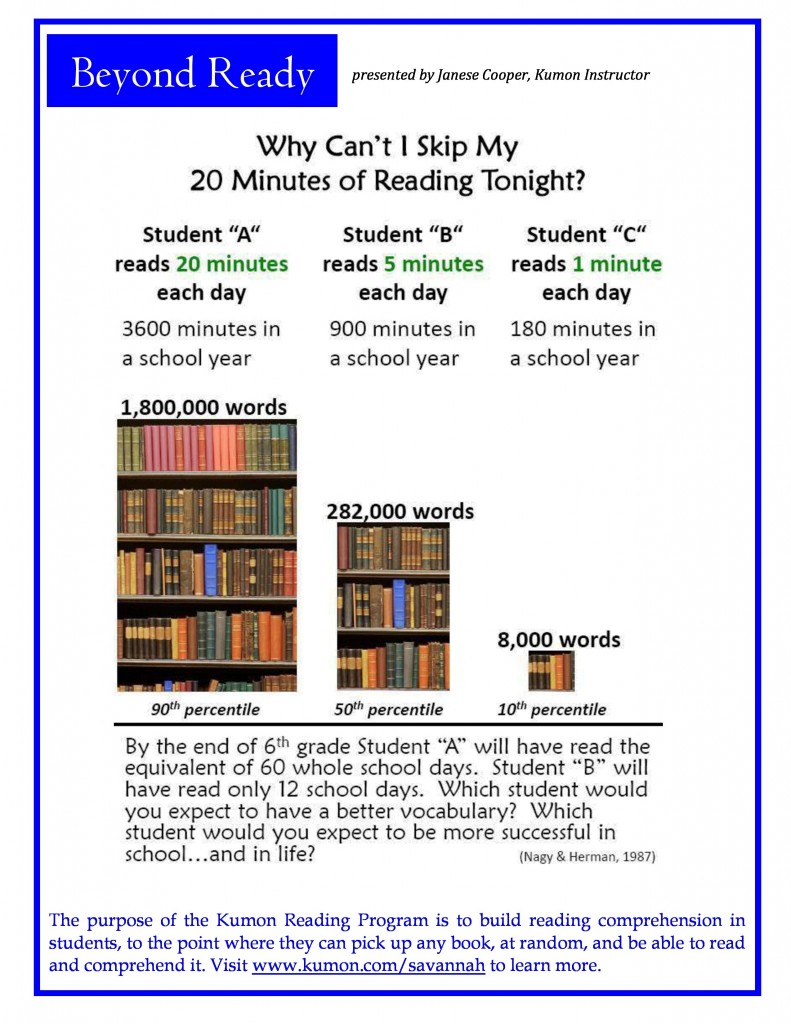
favicon Have you seen these images online? Here’s one.

20minsanight

It looks like James is going to have a better life than Travis. Which, in reality, is true, or at least according to reading researchers.

But what I’ve always not liked about these posters is that there’s no joy in them. Reading is hard work and must be forced like a chore.

If you’re a parent, the right thing to do is to tell your child to go to her room to force read while you finish watching TV.

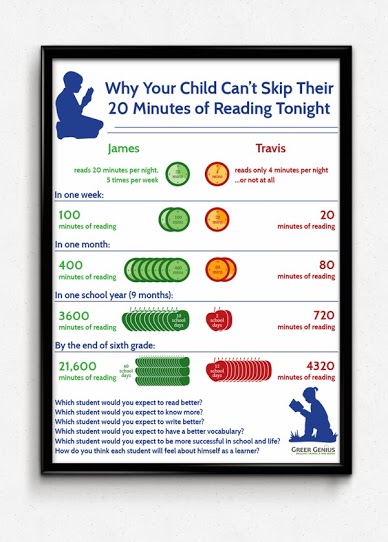
Here’s another:

More20mins

I suppose they could be worse. And there’s nothing wrong with giving parents the facts — that like anything else (practicing piano, playing sports, eating vegetables), a daily habit is the best approach.

But why don’t these images ever have interesting books on them? Or joyful readers? Or parents reading alongside their children?

Why is it a totally normal thing for parents to read to their kids until their kids can read…and then stop entirely afterward, replacing that reading with reading demands and reading logs?

Yes, I know: Parents are busy. But it’s 20 minutes, right? favicon

Two creepy new coaching approaches

favicon Instructional coaching is all the rage in education right now. That’s good for me because it means that I have a job. (Don’t worry, I’m a pretty good coach.)

There are definitely some best practices that I’ve learned over the past year and a half. Some of them are:

  • You have to develop a trusting relationship,
  • Meetings and observations must happen at least weekly,
  • Quick and specific cycles of inquiry are best,
  • You have to believe in the teacher.

Today I watched this video at Teaching Channel. It outlines two innovative approaches to coaching: “virtual” and “real-time.” Both are a bit creepy to me. Take a look:


The first approach, virtual, involves the coach watching a video of the class and typing comments that the teacher can see later. My feeling is that the coach is not in the room live when this is happening. She is watching this video later in the day, off site. At first glance, this seems perfect, right? The coach doesn’t even have to leave the office!

Unfortunately, the whole point about coaching is the personal relationship. There’s nothing wrong with commenting on video. It’s actually good practice, especially with teachers and their colleagues. You can pinpoint specific teacher moves and make quick changes to practice. And there’s also nothing wrong if a teacher wants to send her coach an additional video to look at. But virtual coaching should be an add-on, not the primary method of working with a teacher.

OK, then comes the real-time approach. That is one of the strangest things I’ve seen in a long time. The coach sits in the back of the classroom and tells the teacher what to do? With a walkie-talkie? And the teacher hides her earpiece with her hair so the students can’t tell that she’s saying exactly what the lady in the back is saying?

Though I understand the intention, this real-time coaching is madness. There’s nothing wrong with a coach showing the teacher a new skill. But this could be done alongside the teacher instead of clandestinely twenty feet away. And I’m not exactly sure how this helps the teacher; after all, she’s just repeating what the coach is saying. It’s true that having teachers practice in the moment and participate in role plays does help, but above all, this method is very strange.

Random Thought: What if you combined both approaches? As in: Your coach is not in the room and she’s telling you what to do? Hilarious (though more appropriate, actually, than being in the room).

Maybe I’m just protecting my job, or maybe I’m just old-fashioned, but what’s wrong with working with your teacher to set goals, then observing a class, then talking about it and making next steps?

Please let me know your thoughts. Teachers, would you like virtual or real-time coaching? favicon

Just a quick tweet…

Go ahead, follow me on Twitter! Or contribute to the Kindle Classroom Project!

A beautiful advertisement about the power of reading. (That is, until the last two seconds.)

favicon My friend and colleague sent me a South African commercial tonight about an illiterate man who learns to read.

It’s beautiful. Please watch.

Up until the last two seconds, I was ready to share this advertisement with the teacher-leaders in my network and encourage them to show it to their students.

Too bad for the last two seconds!

Question: Do you think the video is still usable? As in, maybe it’s OK to stop it right before Bell’s Whisky enters the picture? Or would some of you show the entire commercial to your students?

Please let me know your thoughts — and your favorite part of the ad! favicon