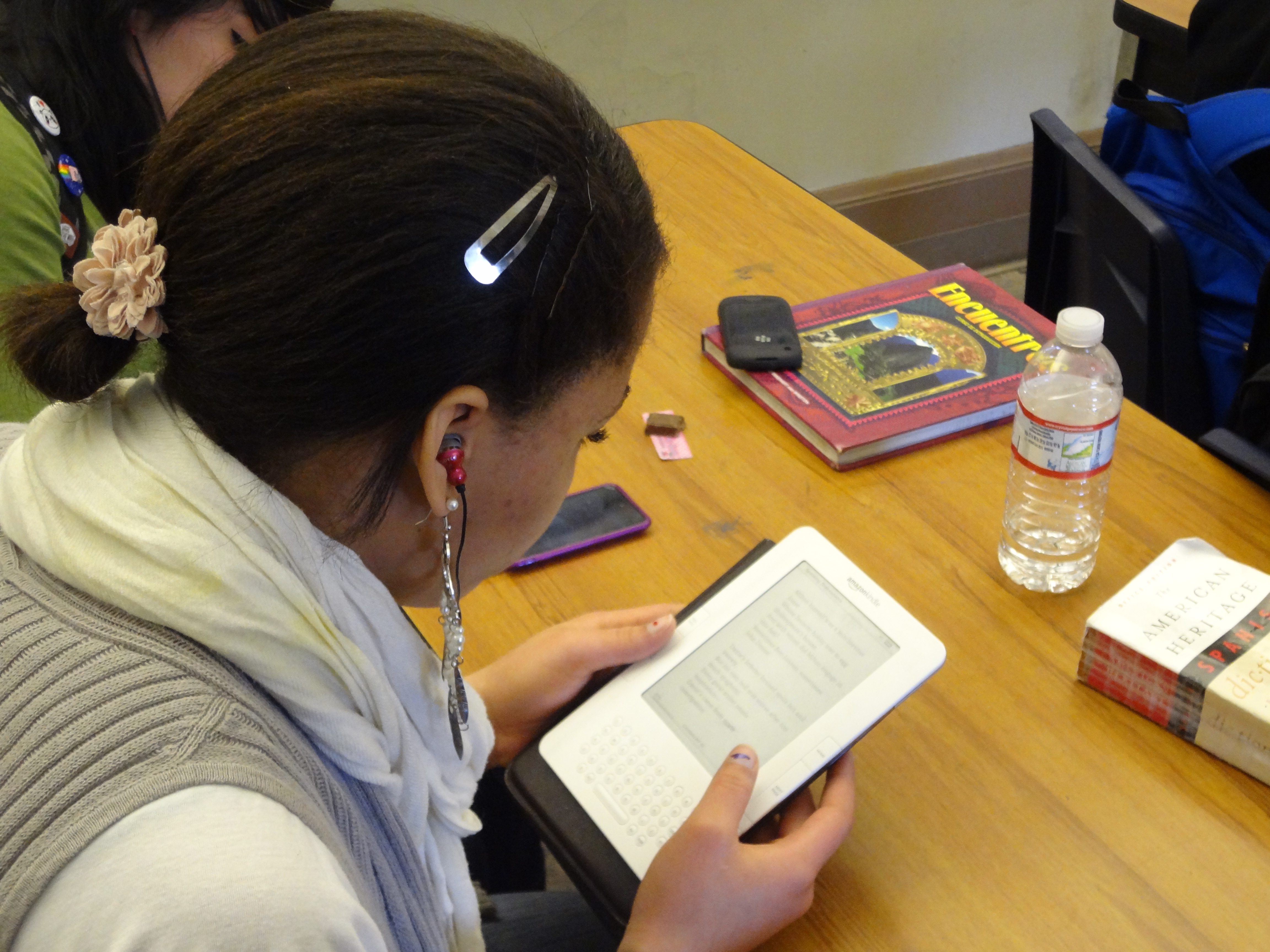
Huge January for the Kindle Classroom Project

favicon After an impressive month of donations, the Kindle Classroom Project is growing at a rapid rate. Contributions in January brought the overall Kindle total to 139.

With 24 Kindles donated, January was the second-best month in KCP’s history. It finished just behind December 2013, which had 28.

Here’s a great graph that I think you’ll enjoy:
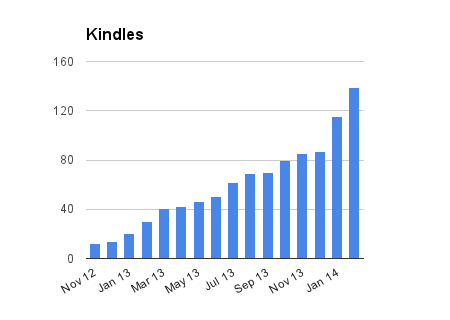
Kindle Growth

I’m not a Math whiz, but something is happening with that graph, don’t you think? Kindle contributions seem fairly linear from November 2012 to November 2013. The last two months, on the other hand, tell a very different story.

It may be impossible to keep up this near-exponential pace, but the fact remains that 52 Kindles have been donated in the last 60 days. Amazing!

Another way to assess growth is to compare recent months to the same month last year. For example, January 2014 added 24 Kindles, while January 2013 netted 10. December 2013 added 28 Kindles, while December 2012 netted 6. That’s a big difference.

Here’s another way to explain the growth: Before December, there had never been a month in which more than 20 Kindles were donated. The closest was June 2013, when we gained 12 Kindles.

The question now is whether the surge will continue. Last February, 11 Kindles were donated. How many will come in this year? While my gut says that this kind of growth can’t possibly continue, I also say, Why not?

What would be the problem, say, if the Kindle Classroom Project had 160 Kindles before March and 200 before June? My students would have no problem with that.

Thank you to everyone who donated in January: David and Linda (Cannon Falls, MN), Matthew (Chicago, IL), Julia (Ann Arbor, MI), Amy (West Chester, PA), Kristzian (San Jose, CA), Rich (via email), Hoai (New York, NY), Jeffrey (via Facebook), Ben (Oakland, CA), Cathy (Iron Station, NC), Kim (Polk City, IA), Jenn (Brockway, PA), Anna (Fort Smith, AR), Emily (St. Louis, MO), Donna (Denver, CO), K.C. (Palo Alto, CA), Jeannette (via email), Roger (West Jordan, UT), Pat (Garfield, NJ), and Cathy (Benton, PA).

I love that Kindles are coming in from all over the country. Is it just me, or is Pennsylvania a particularly Kindle-donating-generous state? favicon

Will Kindles help the lowest-skilled readers?

favicon We’re about to find out!

Beginning next week, a teacher in Hayward will launch a Kindle reading intervention for the eight lowest-performing readers in the 10th grade. The cohort will meet for an hour once a week, focus on the personal and cognitive domains of the Reading for Understanding framework, and read a lot on Kindles.

The six boys and two girls, on average, read at a third or fourth grade level. Most reading specialists and researchers would argue that the students need an intensive, one-on-one program to accelerate their reading growth.

That is likely possible, but the teacher and I are exploring another possibility. What will happen if we build a strong community of readers, where there is support rather than stigma? And what if we use Kindles to encourage voluminous reading?

There’s no guarantee that this will work. But it did last year with a similar group, when students gained more than a grade level in their reading in less than two months.

The intervention will run until June, at which point the teacher and I will analyze the data and see how the students did. In addition to reading scores, we’ll look at some other metrics to determine the success of the program.

I can’t wait to see what happens! favicon

“Characters are just ways of thinking.”

talkabouts_wilhelm2favicon Reading educators Jeffrey Wilhelm and Michael Smith recently interviewed students about the benefits of reading. Here’s my favorite quote from “Don’t Underestimate the Power of Pleasure Reading.” Helen, a 14-year-old, says:

Sometimes when big stuff happens in my life, I’ll think about what my favorite characters would have done, the ones I admire most. They all have different approaches, different ways they approach things, and then I try to apply that to my life, to see which way works for me. Characters are just ways of thinking, really.

Helen captures perfectly one of the best reasons to read. When our lives get tough, and we may need some advice, reading gives us resources to turn to, role models to bounce ideas off of. Sure, these mentors may be fake, fictional characters, but they can help us in real life, too.

In other words, reading can serve as an escape if we want to leave the world for a while. But it’s also one of the best ways to get back to reality and figure out what to do next. favicon

We must teach reading deliberately

favicon By high school, most teachers don’t teach students how to read. There’s an assumption that students either know how or they don’t. If they don’t, that’s too bad.

That’s partly because high school teachers rarely learn about reading in their teacher preparation programs. I remember that I took a reading course two or three years after I received my preliminary credential. Things are likely different now, but any way you slice it (that’s the first time I’ve ever written that), high school teachers aren’t equipped to help students who struggle to read.

We must change this. I’m happy that I get to work with teachers who are.

An example: One teacher in Hayward has founded a reading cohort this year. Teachers meet once a month to talk about how they can teach reading better. Their basic text is Reading for Understanding, which I like. Mostly, they share ideas and try things. I get to attend the meetings, too.

Here are a few posters they made for the classroom:

My favorite thing about this teacher and her colleagues is that they’re not waiting for some expert to tell them “the right way” to teach reading. They don’t expect some important person from the Common Core to deliver a PD. They don’t look to me for all the answers. I’m happy they don’t — because it’s clear that there’s no one right way.

More important than any specific strategy is the consistent consciousness of teaching reading, the professional intent, the deliberate commitment. Little activities are nice, but they’re only effective when teachers think reading is important and are engaged in inquiry around what works. favicon

Pitching Kindles to students is easy

Princess Kindle

favicon Today I visited a high school in San Francisco to see whether ninth graders there would be interested in reading on Kindles.

It was an easy sell.

It’s funny, actually, how easy it was. There was absolutely no skill required. I went in, showed them my Kindle, talked to them for about 30 seconds, and took questions. That’s it.

Their enthusiasm was palpable.

Today, I went in at the end of SSR. Students were reading their physical books. The class was silent, and the students were really reading (rather than fake reading), thanks to their excellent teacher and plenty of high-interest books.

The students were amazed that I’d collected 132 Kindles. They were amazed that adults across the country had donated them. They were amazed that their favorite books — the ones they were currently reading — are in the Kindle library.

Perks of Being a Wallflower? Check. Monster? Yep. Diary of a Wimpy Kid? Got the whole series. Perfect Chemistry? Yep, that series, too. Malcolm X? Sure enough.

And the students asked great questions, too. “Can we take the Kindle home?” Of course. “Are the Kindles sensitive?” Yes, treat it like your phone. “What if there’s a book we want to read that’s not on the Kindle?” I’ll buy it for you.

My favorite part is when unabashed excitement emerges publicly from a student who everyone knows isn’t supposed to be so maniacally interested in reading. Today, that student was a boy, and he was Latino, and before I began talking, he was small and squirrelly. As I made my pitch, he was still and leaned in. Later in the class, after I’d left, and when it was time to sign up, he was on the top of the list.

Something special is happening. The Kindle Classroom Project is getting students engaged in reading again. It’s fixing something that was broken. It’s offering access. It’s telling students, “Reading is for you, too.” favicon