Kindle Classroom Project featured in Kappan!

Kappanfavicon I am very excited to announce that Phi Delta Kappan has published an article I wrote about using Kindles in the classroom.

The April 2014 edition includes “Rekindle the Love of Reading,” in which I tell the story of the Kindle Classroom Project and offer tips to teachers interested in building their own program.

Getting published in Kappan is a dream come true. Nearly 20 years ago, when I was in college, my new passion for teaching prompted me to spend time in UC Berkeley’s Education Psychology Library. My favorite three professional journals were Educational Leadership, English Journal, and Kappan. I remember reading articles and feeling inspired by educators who understood their craft.

Now my name gets to be alongside some pretty well-known folks, like Richard Murnane of Harvard University, Paul Bambrick-Santoyo of Uncommon Schools, and John T. Spencer of Education Rethink.

And it gets better. Also in the April edition is my friend Jennifer Higgs, a graduate student at UC Berkeley’s School of Education. She’s been a loyal supporter of the Kindle Classroom Project and has encouraged me to get my writing out there. Thanks, Jenni!

And then, a wonderful coincidence: The edition also includes an article by Kate McGovern, one of the very first students I ever taught. She was an excellent writer then. I can’t wait to read Kate’s first novel, Rules for Fifty-Fifty Chances, which comes out next year. She also works for The New Teacher Project in Brooklyn.

It’s all exciting and surreal! I’m appreciative of Kathleen Cushman, author of The Motivation Equation (among other books), who encouraged me to write the article and connected me with Kappan’s editor in chief. Thank you, Kathleen, for being such a kind mentor and friend!

Oh, did you want to read the article? No pressure, but if you’d like to, please email me at mark (at) iserotope (dot) com, and I’ll show you how to gain access.

I’m hopeful that the article encourages teachers to consider using Kindles to motivate their students to read. Young people like to read; they just to be reminded that they do. They need support, and time, and enthusiasm, and easy access to high-quality books. favicon

What a classroom library shelf should look like

favicon When teachers ask me to help them build a classroom library, I offer one key best practice to follow: Make it look like this:

2014-03-22 12.00.33

In other words, make it look like a Barnes and Noble. Remember that you want to “sell” these books to your students.

Five copies of each title, I think, is perfect. It means that several students can read the same book at the same time. It also means that the books are easily findable, even if their covers aren’t facing outward (another best practice).

I’ve been slowly collecting popular titles via DonorsChoose. Check out my page if you’re interested in helping out. My biggest question is to whom I should donate these books. My preference is to donate them to one classroom, and I’m hoping to find one teacher who shares my vision and is willing to build a relationship.

Please let me know what you think! favicon

Students do not have very much homework

One of my favorite nonsensical posters.

favicon Homework is likely the most popular and most controversial educational topic out there.

Maybe that’s because parents feel they have to force their kids to complete homework when they would rather play their XBox 360 or PlayStation. (The antecedent “they” is purposely ambiguous.)

I’ve written about homework a lot, too, including this post about what the French think about it. When the French get involved, things get serious.

The latest brouhaha in the homework debate emerged the other day, when the Brookings Institution published “Homework in America,” part of the Brown Center Report on American Education.

Its conclusion? Homework hasn’t changed much since 1987. This means: A few students probably have too much. But there aren’t very many of those students. Far more prevalent: Most students have very manageable amounts of homework.

Here’s a (playful) video that you should watch:

What I found interesting is that 27 percent of 17-year-olds in 2012 reported having no homework. High school seniors said they spent more time socializing with friends, playing sports, and working at their job than doing homework.

In my experience, that seems right.

Here’s where I’m coming from: The students I taught, and the students I’m working with now, do very little homework. My estimate is that the average is less than an hour a night. Sometimes that goes up when a major project is due. But for the most part, homework is not the norm.

According to my colleagues, the primary reason that there’s not much homework is that “students don’t do it.” Depending on the school and the grade level, the homework completion rate ranges from 30 to 90 percent.

Now comes the interesting part. Because few students do the homework, the common result is that teachers assign less. Here are a smattering of reasons I’ve heard:

  • What’s the point of assigning it if the students aren’t going to do it?
  • If I assign it and they don’t do it, then the achievement gap gets even worse.
  • My homework requires technology, and not all students have computers at home.
  • Many of my students have challenging home lives, so I can’t count on homework getting done.

I totally understand the natural reflex of teachers to decrease the amount of homework. It’s normal. Unfortunately, it lowers expectations. It tells the students that we expect less of them.

There are educators (like Alfie Kohn, for instance) who would rather get rid of homework altogether. They claim that homework is an outgrowth of the factory model of education and is oppressive to children’s creativity.

Most of my colleagues are not in this camp. Very few of them would say that homework should be abolished.

While I do not equate homework with rigor, as some people do, I do see a problem when my students, who aspire to do good things, are doing less than an hour a night (and thinking that’s normal) while my eighth grade niece, who lives in the suburbs, does 2-3 hours and is attending an elite high school in the Fall, on track to attend a UC school or better.

I believe that we have to tell our students the truth, over and over again.

It’s not that our students have to be just like me, who probably spent too much time doing homework as a kid. (My average: Probably 3 hours.) But if they’re truly serious about attending college, then we as educators need to figure out a way to insist and require that students do significant academic work outside the regular school day.

Certainly this might mean changing things up — for example, changing the bell schedule so that students can begin homework at school. Some schools extend the day and hire tutors to help students do their work.

However we do it: Instead of retreating from homework and dismissing it as a dirty word, let’s embrace it, call it our friend, make it happen. favicon

The confusing new terrain of grit

gritfavicon OK, now I’m totally confused.

I used to think I understood the concept of grit and its importance in education. It’s the non-cognitive skill (or character trait) studied by Angela Duckworth, psychology professor at the University of Pennsylvania, and made popular by writer Paul Tough’s book, How Children Succeed.

I thought I understood grit so much that I wrote about it a few times and even taught it to my AP English students two years ago. When they faltered during Fall semester on their essays, I reminded my students of their strength, and I explained that long-term success came from long-term determination. Grit became a buzzword in our class — and occasionally a joke, particularly in our morning classes when my students were hungry and wanted the plural form for breakfast.

Now, two years later, National Public Radio this morning put out not one but two reports on grit, and I’m thoroughly confused. (The reporters call grit “the new thing in education.”) Both are around seven minutes long and worth listening to.

Here’s the first one:

This first report solidified my hunch that grit has been claimed (and possibly co-opted) by conservative educators. Perhaps the shift began when Dave Levin of KIPP became interested in the non-cognitive skill. KIPP schools now teach and assess students on grit, and Mr. Levin teaches a Coursera course on building character in students. As Alfie Kohn argues in the piece, grit is becoming a “virtue” that conservatives like William Bennett would say that “good” students have and “bad” students lack. To Mr. Kohn, grit is an ingredient of a “bootstraps” mentality.

If the first NPR report made me queasy, the second one totally confounded me. Here it is:

Yes, I understand that “smart” is a dirty word. But grit is the outcome of growth mindset? Interesting. Sure, I suppose that makes sense, but I’d never heard the two terms in the same sentence. Certainly Stanford professor Carol Dweck, author of Mindset, wouldn’t want to fraternize with the new grit folks, would she? Now I’m not so sure. The lines are being blurred!

And maybe that’s a good thing. I’ve always disliked the dichotomy in educational discourse. The truth is, There’s nothing wrong with grit and growth mindset existing together. We can all like them! Who wouldn’t want their children to be resilient and see challenges as opportunities for growth?

Unfortunately, nothing in education is that simple. The people who make policy have the power and the resources to shape how we understand and use concepts like grit and growth mindset. It’s all about metaphor. A good word in educational reform today may be a bad word tomorrow, and vice-versa.

Confused yet? (I am.) By the way: Thank you, Michele, for letting me know about the first NPR piece this morning! My loyal Iserotope readers are also great reporters! favicon

The Apartheid of Children’s Literature

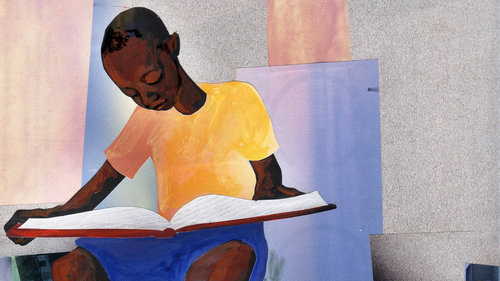
apartheidlitfavicon Laura, my friend and sustaining donor of the Kindle Classroom Project, sent me a New York Times op-ed this morning that decried the lack of people of color in children’s literature.

According to a study by the Cooperative Children’s Book Center at the University of Wisconsin, there were 3,200 books written for children last year. Of those, only 93 were about Black people.

My calculator says that’s 2.9 percent.

In a piece in today’s Sunday Review, Christopher Myers goes even further. He argues that there exists an “apartheid of children’s literature.”

In the op-ed, Mr. Myers writes that children see books as maps, as pathways toward their futures. If children don’t see themselves in books, they have trouble imagining diverse possibilities.

A fifth grade African American boy tells Mr. Myers that he wants to become a professional basketball player and a rap star when he grows up. To this Mr. Myers reflects:

Looking at him, I think that these are not necessarily his dreams; they are just the dreams that have been offered him, the places he can go in the narrow geography that has been delineated for him….As much as I hope that I’m wrong, that in several years the Brooklyn Nets sign a 5-foot-8 point guard with amazing flow, who raps and hoops in the same arenas, I think it’s necessary to provide for boys and girls like him a more expansive landscape upon which to dream.

When I was a teacher, this scene happened over and over. Most of my students had trouble envisioning their futures and the steps needed to get there. Though he does not state it explicitly, Mr. Myers implies that the lack of people of color in children’s books leads to less reading by children of color, thereby resulting in fewer trajectories as they grow up.

By no means do I assert that kids of color must read only books that include kids of color, but I do agree with him when he calls on “publishers, librarians, teachers, parents, and all of us” to fight against this apartheid by putting the right books into children’s hands.

I’m proud to say that the Kindle Classroom Project is making a contribution to this issue. Kindlers are 99 percent students of color. Sixty percent are boys. My other project, helping teachers build classroom libraries, is also starting to make a difference.

These efforts are made possible by generous donors. If you’d like to help out, please check out the new and improved Contribute page!

(Related article from the New York Times in 2012: Just 3 percent of children’s books in 2011 were about Latino kids.) favicon