I’m not pro-testing. But this is silly.

favicon Protests against standardized testing are heating up this year as we head into assessment season. Some parents are opting their children out of the mandatory tests, and educational leaders like Diane Ravitch are calling for more boycotts.

I don’t mind the protesters. They have a good point — that maybe there’s too much testing, that it reduces the humanity of their children to a zombie-like state. It’s an important debate. Even though the new Common Core State Standards will likely reduce the overall amount of testing, I can see why parents and their children might feel frustration.

But pictures like this make me crazy.
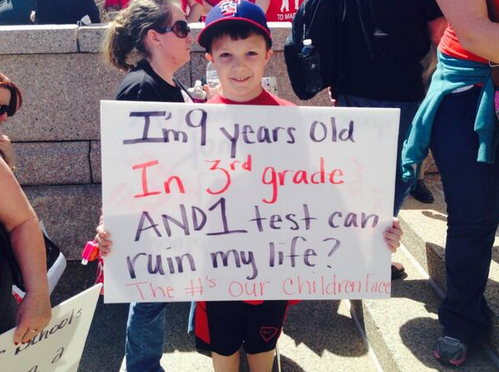
Antitesting Pic

Here are a few reasons this protest is silly:

  • Sign made by the parent, not by the child.
  • No, one test cannot ruin your life.
  • Doesn’t help that the child is smiling.

It just doesn’t make sense to argue that your 9-year-old boy is a robot of standardized testing and then force him to a protest with a sign that you made yourself.

Of course it’s normal that things get heated when people become impassioned. Unfortunately, the education debate is now strongly either-or. Either you are for public school or you’re for corporate privatization. Either you’re for creativity and humanity or you’re for standardized testing. Either poverty is the reason for everything bad in education, or teachers are.

Some say that a real conversation wouldn’t get us anywhere. A false compromise is what the corporate reformers want. A revolution is necessary.

That’s fine. There’s nothing wrong with revolution, but please, while you’re at it, have your students reading a book of their choice instead of standing behind a sign they didn’t make. favicon

Problems with personal anecdote as evidence: Racism in school discipline is alive and well despite your one story to the contrary

shutterstock_151229789favicon A study released by the U.S. Department of Education Office for Civil Rights is causing a big stir. Among its findings, the report concluded that African American preschoolers are suspended at a higher rate than white preschoolers and that they receive harsher punishment for similar transgressions.

If you’re a teacher, this isn’t surprising.

But tell it to readers of the New York Times, as the newspaper did a few days ago, and (white) folks get a little crazy.

Yes, I read the comments that accompanied the article. Usually calm and intellectual and reasoned, New York Times commenters, especially when discussing race, have become unhinged of late, spewing vitriolic (though largely well-written) arguments that lack any real evidence. Instead, most commenters have relied on personal anecdote (and white privilege) to make their points.

Here’s an example (not even one of the most incendiary):

One of my fellow teachers was attacked by a Kindergartner who called her cracker, white bitch and a host of racial epithets; he was suspended only after attacking her with a pencil, where he attempted to stab her. She was then told by administrators that if she could not deal with the situation, she should not be teaching in such a district (translation: here’s the door, cracker).

Here’s the deal. What happened to your friend is unfortunate. I’m sorry. But your friend’s personal anecdote does not outweigh the study’s data, which includes every school in the nation.

Just because we all went to school, and just because many of us have taught in public schools, and just because we have perhaps witnessed bad behavior by young people, white and Black — this does not mean that we can negate the systemic racism, manifested in discipline practices, that occurs in our nation’s public schools.

I understand that we need to have honest conversations about race, and the commenters are expressing their honest opinions, which is fine. But I wish that more people knew how to engage in the conversation. Unless you’re a statistician, disputing the statistical findings of the Office for Civil Rights is not a good idea. Your story of woe is not going to cut it.

It’s not up for debate that school discipline policies are racist. That’s a fact. But what can be discussed is what to do about it. That question was not included in the study. If more people engaged in that dialogue, maybe we could get past our own personal experiences and come up with ideas that’ll get us somewhere. favicon

California case challenges teacher tenure

david welchfavicon This one’s a doozy.

I predict that traditional policies of teacher tenure in California will come to an end in the next few weeks after the decision in Vergara v. California.

Nine students of color are the plaintiffs in a case in which they argue that they received an inferior education because of tenured teachers who could not be fired. Multimillionaire David Welch has has spent more than $3 million so far on counsel, which includes Theodore Olson.

Check out this excellent report by the PBS NewsHour:

My initial response is: Yes, every single student deserves a high-quality education, and ineffective teachers should not be in classrooms. It is also true that students of color are more likely to receive incompetent teachers.

But I’m very worried that this case is just a means to dismantle teacher unions. Depending on how the judge rules, teacher protections could be weakened or even eliminated. An outspoken teacher could be let go for her convictions.

Unions exist in education for a reason. Teachers serve a public interest. They are not paid well, especially in urban districts. They are not respected by society.

My friend and former colleague Ninive Calegari argues that teacher salaries should be doubled. Founder of The Teacher Salary Project, Ms. Calegari cites a 2010 McKinsey report that concludes that teacher salaries have dropped over the past 30 years. If salaries went up at the same rate as educational spending, Ms. Calegari writes, a typical teacher would now earn $120,000.

Therefore, there’s something about Vergara v. California that is missing the mark. If the plaintiffs win, some bad teachers will be fired, and that’s a good thing. But many good teachers may also be in jeopardy.

Furthermore, a victory for Mr. Welch and the students would do nothing to increase teacher salaries. It would do nothing to increase the respect of the teaching profession. It would do nothing to encourage young people to make teaching a career.

As you can see, I’m a bit torn. I would love to know your thoughts! favicon

Promote reading with March Madness

favicon Here’s a great way to promote reading in your classroom: Do a March Madness tournament of your students’ favorite books!

This idea comes from Megan Everitt in Central Ohio. Take a look at her bracket.

Reading March Madness

I got to tweet back and forth with Ms. Everitt. This is what she does: (1) Select her students’ favorite books from the year, (2) Put them in a bracket, (3) Have students vote, round by round.

Here’s a modification I would do: (1) Create the bracket based on popularity. A #1 seed is the most popular book of the year, for instance, (2) Have students pair off and read both books and then determine the winner, (3) Continue this process until there is a class winner.

My March Madness is a little involved and would take longer than just one month. But students could begin in January and finish by the end of the March, especially if they’re reading one book a week.

One big negative about my choice is that it decreases choice. Students have to read the books in the bracket. On the other hand, for reluctant readers, or students coming back to reading, this approach could bolster reading momentum and encourage students to read outside of school.

What are your thoughts about March Madness? favicon