100-Kindle goal smashed, obliterated!

favicon At the beginning of December, just two weeks ago, I announced a bold goal: Let’s reach 100 Kindles by the New Year!

It was a bold goal because at the time, the Kindle Classroom Project had 87 Kindles. There had never been a month in its history where 13 or more Kindles had been donated.

Today, I am very happy to report that the 100-Kindle goal has not just been reached. It has been smashed, obliterated, squashed, crushed, shattered — and many other words!

We now have 111 Kindles!

Most of the credit goes to DSW (Saratoga, CA) for their $2,000 donation, which allowed for the purchase of 20 new Kindles. Want to see? Here’s the biggest Kindle stack in KCP history!
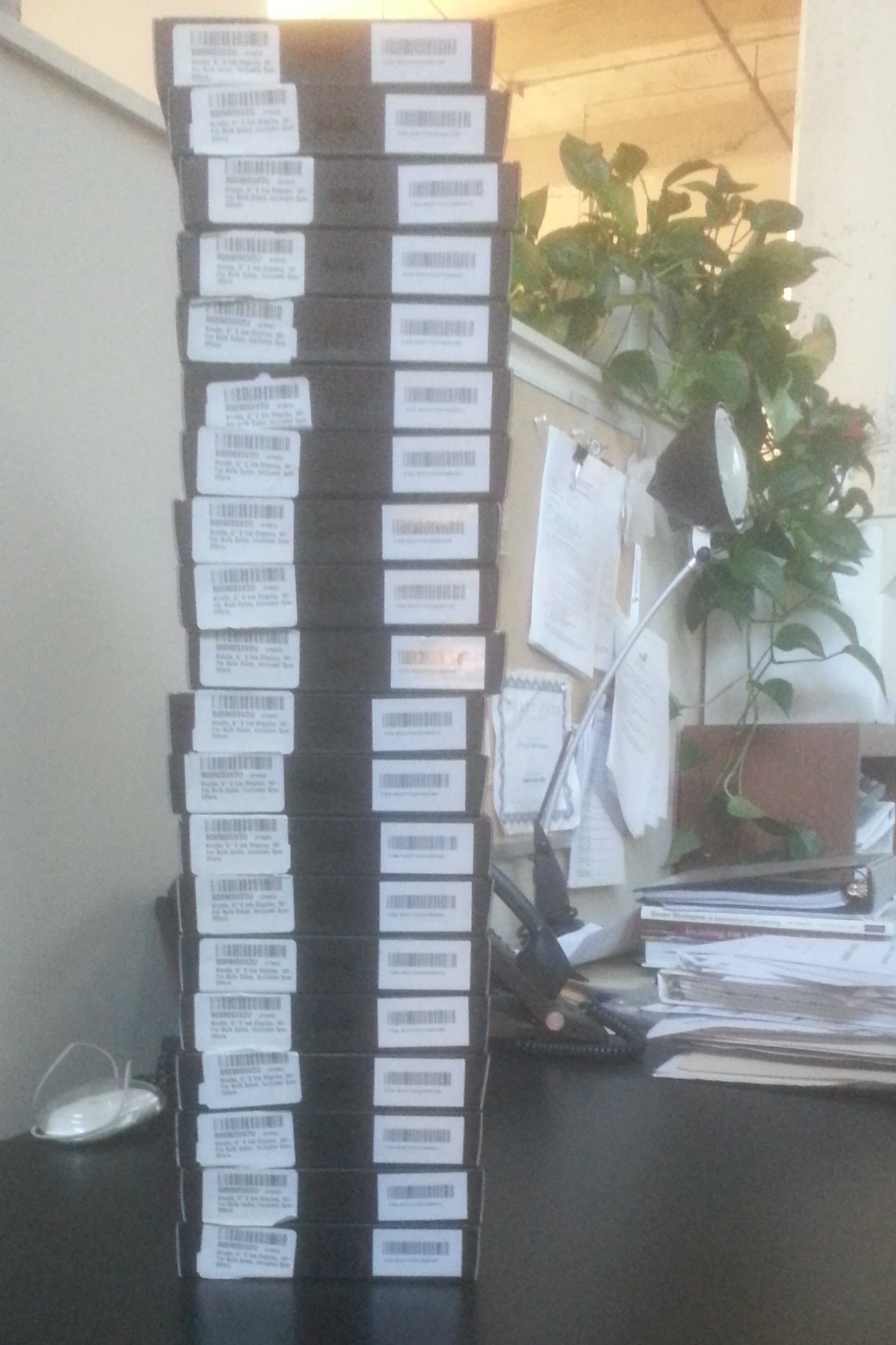
20-Kindle Stack

Yes, the stack keeps going and going. Thank you, DSW, for your continued support of young people and their reading lives. Your generosity will now make it possible for every single ninth grader at a school to receive a Kindle!

Though DSW’s gift has made the bulk of Kindles possible, many other donors have made Kindle contributions this month. Here is a quick list: Matthew (Chicago, IL), Julia (Ann Arbor, MI), Mikey (San Francisco, CA), Amber (Wilkes-Barre, PA), and Deborah (San Francisco, CA). It’s amazing that people find the Project through its Facebook page or its Donate Your Kindle page on Iserotope.

Plus, there are more Kindles to come. In fact, it’s possible that the KCP will reach 120 Kindles by the start of 2014! It’s all amazing.

In addition to Kindles, I’ve received e-books (thank you, Charles), physical books (thank you, Iris), cases (thank you, Mikey), money (thank you, Wil), and batteries (thank you, Saugut and Mary). It takes generosity of many kinds for the KCP to flourish.

Finally, it’s becoming clear that it takes a combination of sustaining donors and new donors to help the KCP to grow. One of my favorite things is hearing that a new donor heard about the project through word of mouth. Though the Kindle Classroom Project is still somewhat small, it’s possible that 2014 will bring some new big things! favicon

I guess I read a lot of non-fiction, too

favicon Some years I read between 70 and 80 books. Other years, like this one, I read much less — more like 30 to 40. There’s always some guilt when I have an “off” year. After all, there’s tons of great stuff to read, and especially now that I’m not a classroom teacher, there really isn’t a great excuse.

There’s a pattern, though, to my off years: I tend to read more nonfiction, especially online. It’s not the same, of course. No matter how much I read articles from Longform, my favorite curator of long-form articles, there’s nothing that replaces a book. But most of it is still good reading.

The other day, I received this email from Pocket, my favorite phone app of all time.

Screenshot 2013-12-15 16.20.10

You see? I get an A!

Apparently, I read nearly 3 million words this year on Pocket. How does it know? Is this number based on the articles I opened? Or is it based on the articles that I’ve saved? Or does Pocket actually scan my eyes as I read or determine whether my brain comprehends what I’ve read? It’s a mystery.

At least I’m reading, though, and many of the articles I’ve read have made their way to Iserotope Extras or been saved to my Evernote.

That’s good, but what I really want is a way to talk about these articles — in the same way that I like talking to people about books. Pocket doesn’t do this (yet), and comments on the bottom of articles are never very good. Maybe someone in 2014 will be the year that social reading takes off. favicon

Building a culture of reading at a school in Oakland

2013-12-12 08.00.09favicon Today I was at the Oakland school, which always brings me tons of joy, and I got to read with the Kindlers during the 25-minute Sustained Silent Reading period.

(Spending good time with the Kindlers will be an entirely separate post!)

I have a lot of respect for high schools that dedicate a significant part of their schedule to SSR. After all, SSR is controversial. Some say that it doesn’t work, and others say that even if it works, it’s not appropriate for schools to devote so much time to independent reading, particularly in this time of the Common Core State Standards.

Blah blah blah.

OK, sure, it’s possible to do SSR poorly. Here are a few ways: (1) Don’t have enough good books, (2) Let kids fake read or do homework, (3) Pretend you care about reading when really you don’t.

I’m pleased to report that I get to work at a school where SSR is going brilliantly. The depth of silence across the school is profound. The students are all reading, and they’re curling up when they’re reading, and it’s eminently clear that they’re enjoying their books. When the 25 minutes is up, students don’t want to stop.

As a reading advocate, I believe, of course, that voluminous reading is the most important outcome of SSR. But a close second is the calm that SSR generates. Whereas other schools focus on mindfulness or meditation, this school gets the same result through reading. The students are still, and they dive into a different world.

There are benefits for the adults, too. They’re also reading. They’re not taking attendance or shushing students or getting ready for their lessons. Staff members who are not classroom teachers are reading as well. In fact, the main door to the school is locked, and there’s a sign that says that visitors should return after SSR is over. The school shuts down so that everyone can read. The only room with non-reading activity is, ironically, the library, which students visit to return finished books and check out (from student librarians) new ones.

It’s clear that this is all super impressive. I’m particularly happy because this is the school’s first year building a culture of reading. Much is possible in four months. The staff is absolutely committed. I also give the Principal a lot of credit. Not only did she find $10,000 to found the library (we’ve spent $4,000 so far on books), but she also has done a good job observing and reporting the data about how SSR is going. Money is important, but so is leadership and a high-functioning and passionate staff.

Here are a couple more photos of book door displays! (Note: Many schools have door displays of what teachers are reading. It’s much more powerful to have door signs of what students are reading.)

2013-12-12 07.59.54

2013-12-12 08.02.01

The school has big plans for second semester. After last week’s successful Book Fair, students requested three books they might like. Today I ordered each student a book! Librarians will organize and deliver the books to students either next week or right after break, depending on how quickly they can get through the project. Here’s my favorite part: After a lot of debate, it was decided that students will not get to keep their book after reading it. Instead, they’ll donate their book — complete with a sticker with their name on it — to build the school library. (Yes, it’s forced donation!)

I’ll keep you posted, but in the meantime, please let me know what thoughts and questions you have! favicon

“It’s, like, the first book I’ve ever gotten into.”

{2C0F2136-CA7B-49F6-A2D5-7262BD982CA7}Img100favicon Today I was hanging out at the science fiction table at the Oakland school’s first annual book fair, talking to students about books they liked.

A young man approached me timidly and asked, “Do you know of any books like My Bloody Life?”

I know that book really well, it turns out, and it would have been easy to make my next move. But I didn’t want to get too excited too quickly. That would turn the kid off. The conversation, I’ve learned, is as important as the recommendation.

So I asked him about the book, what he thought about it, why he liked it.

The boy’s eyes widened, and then he paused. After looking around and shifting his weight, he launched into an ode to Reymundo Sanchez and his book. He talked for more than two minutes without interruption. “It’s, like, the first book I’ve ever gotten into,” he said. I listened and nodded.

And then he asked, “Have you read it?”

This yielded several more minutes of conversation. He could tell not only that I had read it but also that I had understood it, appreciated it, seen the value in it.

It was time for me to offer something. So I said, “You know, he wrote a sequel.”

“Really? Are you serious?” His smile was huge.

And so I told him about Once a King, Always a King. I didn’t tell him about the 30+ other books that he could read after finishing up with Mr. Sanchez’s work. That could wait. Certainly I didn’t share with him my personal favorite, Jimmy Santiago Baca’s A Place to Stand. This, after all, was about his reading journey, not mine.

But I did ask his name.

“Mario,” he replied.

And then he reached out his hand to shake mine. favicon

Putting on a book fair, the easy (and free!) way

2013-12-06 08.47.36favicon As a literacy coach, my primary job is to work with teachers to improve reading and writing instruction. But a related goal is to help promote a culture of reading among students.

So far, it’s been really fun — and we’ve had quite a bit of success!

Last June, the principal at my Oakland school had a dream that came from a warm childhood memory. “Can we have Scholastic come to our school and do a book fair?” she asked.

I said sure, but Scholastic is better known for its books for younger kids. Their selection for urban teenagers of color is extremely limited. Plus, their book fairs are either expensive or tough to manage. There’s a lot of set-up and upkeep and takedown and drama.

So I countered. “How about doing our own book fair?” The principal agreed but wondered how we would pull it off. “Won’t it be a lot of work?”

It turns out, no, it didn’t take a lot of work. Actually, it was pretty easy, thanks to the wonderful teen librarians at the Oakland Public Library. The vice principal and I called up Brian Boies, the lead TeenZone librarian, and his staff pulled 150 high-interest titles (both fiction and nonfiction) for us to borrow for the book fair. I drove over in my Honda Civic and loaded the back seat with mountains of books.

Then, we elicited the help of our student librarians, who have already gained fame this year after founding the school’s new library. They sorted the books into genres, got tables and signs ready, and double checked the day’s schedule. English teachers brought in their classes in 20-minute installments, and each student got to browse, talk with the student librarians about books, and write down three titles they might want to read.

Here are a few more photos from the day:

Here’s the best part: The principal has decided to allocate funds so that all students will receive, right before Winter Break, at least one of the books on their list! Not a bad way to go into vacation!

Even if the book fair did not lead to the purchase of new books for students, it would have been a big success. Students got connected to good books. More important, students got connected to other students who like good books. There was much joy, and the joy was about reading. favicon