(Also important: Knowing that the “n” is always lowercase.)
A few weeks ago, generous donor Donna from Denver donated several e-readers, including two 1st generation nooks.
I’ve been playing around with one of them. My initial review: I sort of like it! (Please don’t tell the 139 Kindles.)
What I Like
– There’s a color touchscreen on the bottom. It’s playful and more user-friendly than the early generations of the Kindle. Everyone likes a touchscreen, especially my students.
– It has page numbers. The nook gives you what page you’re on, rather than a “location.” This seems more human.
– The menu is easier to access. It’s easy to skip to another chapter and more intuitive to do some other key things.
– Dave Barry wrote the user guide. This actually doesn’t make a difference, but I liked some of his tips for taking care of your nook. (1) “Never put your nook into a blender without a really good reason.” (2) “Keep your nook away from raccoons.” (3) “If an armed person says, ‘Your nook or your life,” surrender your nook.”
What I Don’t Like
– The screen isn’t great. It’s a first generation device, so I wasn’t expecting a great screen, but I found it harder to read on than the early Kindles.
– It’s not easy to look up words. There’s no five-way controller, so it takes forever. If I were a student, I’d just skip the word and read on.
– The touchscreen isn’t sensitive enough. You really have to press down with significant force. And don’t try to type out a note; it’ll take forever.
Overall, I think the nook is solid. I’m going to get the two nooks out to students and see what they think. My hunch is that they’ll like them a lot and maybe prefer them to Kindles.
But for right now, at least, I’m not ready to ask for nooks or change my little program to the Kindle and nook Classroom Project. The biggest reason is that Amazon already has my allegiance, and books on the Kindle don’t work on the nook, and vice-versa. It just doesn’t make sense to purchase both the azw3 and the epub versions of each e-book.
Another reason is that I still think that Barnes and Noble is going to go out of business. Amazon may discontinue its E Ink Kindles, but the company itself, despite its limited profits, isn’t disappearing anytime soon.
Please let me know what you think. Should I open up donations of nooks? If so, what would be the benefit? Thank you!
Today I gave out 10 new Kindles to ninth graders in San Francisco. It was really fun. One by one, I called each student to the back of the classroom to have a little conference.
I’ve found that these conferences give me a chance to demonstrate how serious I am about their reading. I ask the students what book they’re reading, what their favorite book has been this year, and why they’re interested in reading on a Kindle.
If a student is reading a book that’s not on the Kindle, I can immediately purchase the book, thanks to many generous donors. Today, I bought five books to ensure that students felt they could read exactly what they want to read. Also, I made sure to let the students know about the online book request form. (This year, 40+ books have been requested and bought.)
Another great thing about these conferences is that I can emphasize to students the importance of taking care of their Kindle. Kindles are very fragile, especially for 14-year-olds, and while I no longer go crazy when one is damaged, I want to send a strong message to be careful. My favorite things to say are, “Don’t smush it,” and “Treat your Kindle like your phone.” The second one, in particular, seems to work.
I continue to find that boys — especially Latino boys — love reading on Kindles. Today’s Kindles went to 4 Latino boys, 3 African American boys, and three Latina girls.
Also, Kindles tend to go to students below grade level on their reading. Only one of 10 students today who borrowed a Kindle is above grade level. Four students have fifth grade reading levels or below.
One Latino boy, Julio (not his real name), is particularly excited about reading on a Kindle. This year, he has read three books in paper, and and first semester, he raised his reading score from 3.2 to 4.2. When I asked him today why he wanted to read on a Kindle, he said that he didn’t want to have any lapse between finishing one book and beginning another. He added that he’s happy with his reading growth this year so far but wanted to score at least a 7.0 by the end of the year.
These days make me very proud of the Kindle Classroom Project and extremely appreciative of its many donors.
I write a lot about the joy of reading. There definitely is joy. But I’m as interested in the power of reading. Young people who read are not dependent on other people. They don’t need to rely on television or other visual media. They can go wherever their curiosity leads them.
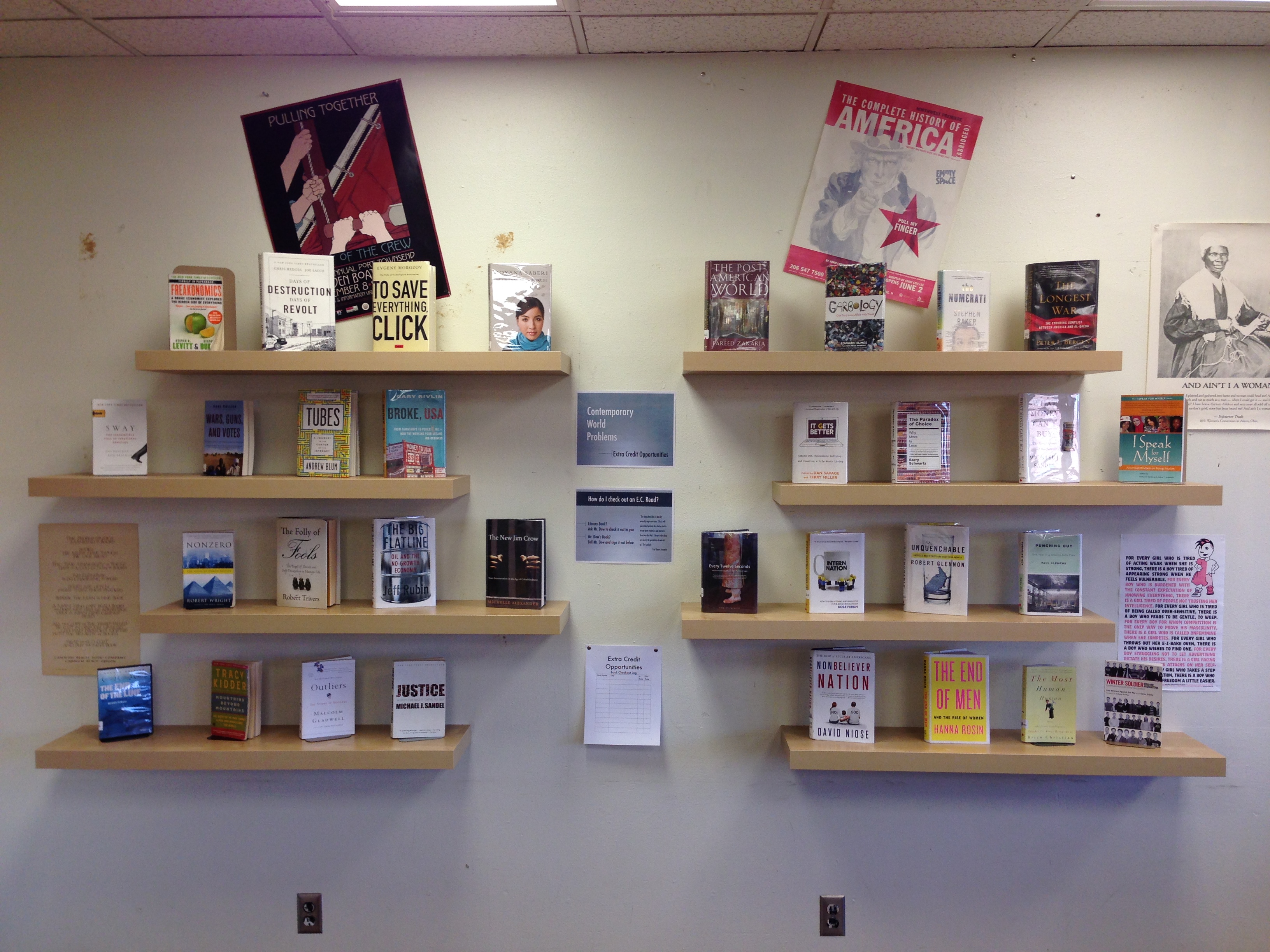
Check out this beautiful classroom library in Port Townsend, Washington. It makes me happy. I love it.
Major props go to Ben and Julie Dow, teachers extraordinaire, for the elegant construction. Behold! Not even a surly non-reader could pass by this beautiful book display unmoved.
There are many reasons this classroom library is wonderful. Among them:
1. Book covers face forward.
Ben and Julie know what bookstores know: Nobody wants to look at a book’s spine. The cover is where the action is.
2. Books are displayed, not shelved.
Shelves are for book-keeping, not book-reading. There’s nothing wrong with a bookshelf, especially when the shelves are narrow. But there’s nothing better than a book display.
3. Fewer good books > More not-so-good books.
This is one of my big mantras. Ben and Julie curate their classroom library so every title counts. There’s no glory in collecting thousands of ragtag books that no student will read. Corollary: Just because 1 of your 100 students will read The Mill on the Floss doesn’t mean you need to stock it. Better to get books that will move.
Want to see more? Here’s the library from a couple more angles:
It’s classy. I’m very impressed.
Of course, I should know to expect this level of quality from Ben and Julie. They’re advanced. They’ve been my friends for years, plus I co-taught American Studies with Ben in the last century. There were plenty of hours spent in their apartment grading, planning, and grading and planning some more.
Now, 15 years later, Ben and Julie continue their excellent work. Now I want to encourage some of my colleagues to do the same — partly for the students and their reading, and partly out of healthy respect and competition, to tell Ben and Julie, “You see? We can do this, too!”
What do you think? Please leave comments for Ben and Julie!
My colleagues and I used to begin our interdisciplinary American Studies class with a close reading, and then a Socratic Seminar, of the Pledge of Allegiance.
It was a great way to get kids to read, think, and speak from the very first day.
But if I were teaching an American Studies or U.S. History class next year, I’d likely start off with “America the Beautiful.”
Coca-Cola’s Super Bowl commercial — which included singing in English, Spanish, Keres Pueblo, Tagalog, Hindi, Senegalese French, and Hebrew — has made the tried-and-true patriotic song a political hot topic, and perfect for some analysis.
Here are a few things I’d do.
1. Have students read the lyrics on their own. In this first-draft read, students would monitor their understanding, mark their confusion, and ask questions. The words aren’t easy. Here are the first four stanzas of the 1904 version:
O beautiful for spacious skies,
For amber waves of grain,
For purple mountains’ majesty
Above the fruited plain!
America! America!
God shed His grace on thee,
And crown thy good with brotherhood
From sea to shining sea!
O beautiful for pilgrim feet
Whose stern impassioned stress
A thoroughfare for freedom beat
Across the wilderness.
America! America!
God mend thine ev’ry flaw,
Confirm thy soul in self-control,
Thy liberty in law.
There’s a lot there — just on an explicit level. What are “amber waves of grain?” What’s this about purple mountains? Immediately we can see how just understanding the words takes word knowledge and background knowledge, combined.
2. Model re-reading a stanza or two with a focus on analysis.
Um, Stanza #3 is particularly intense. Is poet Katharine Lee Bates suggesting that the pilgrims’ Protestant ethic resulted in a Manifest Destiny that forged freedom (against native savages) across the frontier? (Frederick Jackson Turner’s thesis was published just 11 years prior.)
Sure, newbie students wouldn’t necessarily be able to follow that level of analysis, but it’s important to demonstrate how meaning emerges through re-reading, close reading (Common Core, New Criticism), prior knowledge of American history, and the reader’s prior experiences (Reader Response).
3. Have students practice re-reading with a partner, then discuss.
What else do they see? What do they notice? This might be a good time to have students share their questions and thoughts. Depending on the class, they might want to talk about Ms. Bates’s main claim and whether they agree. Or perhaps it would be time to introduce the off-text-but-related concept of the American Dream and whether students think it exists.
I would guess that many students would openly question the outright patriotism of the song. Others may worry that the lyrics aren’t inclusive, that they emphasize a Christian god, or maybe that their message is outdated, not right for our post-9/11 times.
And then, the turn.
4. Have students watch the commercial and see if their viewpoints change.
How did they feel? Do they feel more positive, more patriotic? If so, why? What’s the impact of transforming the lyrics into music? What’s the impact of adding the visual aspect? And, obviously, what about the choice to include seven languages?
Depending on time, consider doing a re-read of the commercial to identify techniques of pathos. How does Coca-Cola make us feel what we feel?
But we’re not done yet.
5. Have students read some tweets in response to the commercial.
The tweets are everywhere: here, here, and here, to name a few. Here’s just one example:
Any one that calls himself a true American should not swallow a drop of Coca Cola.
After students read the tweets, get their reactions. But also push students to consider underlying values and assumptions that the tweets reveal. Students may say, “There are a lot of racist people out there,” which could prompt the question, “Yes, but where do those sentiments come from?”
Also, the hope is to have students summarize their feelings after reading each text. Why were many cynical after the lyrics, hopeful and proud after the commercial, and angry and aggressive after the tweets? How do we interact with words, images, and various media?
6. Have students talk and/or write about a big question.
This is an introductory lesson, so the specific prompt doesn’t matter too much. But the key is to ensure that students are writing from evidence in the text and having the sources talk to each other. A possibility:
According to the three authors, what does it mean to be an American? With whom do you agree most, and why?
How do the three authors define the beauty of America? With whom do you agree most, and why?
There are other prompts, of course, which may be more creative (but require less textual evidence). For example: (1) Ms. Bates, the Coca-Cola commercial director, and Mr. da Silva are in a room together. What do they say? (2) Why do you think the Coca-Cola commercial was controversial, and do you think it was effective in its purpose?
Anyway, there it is. What’s great is that this lesson could take just one class period or could be extended over 2-3 days. The writing could turn into something formal. There could be a little research involved. And maybe the students might need a more formal setting to practice some academic discourse. Ultimately, of course, it’s up to the teacher’s goals and what the students bring to the conversation.
Please let me know your thoughts! I welcome your feedback. Let’s consider this a tuning protocol.

 If I’m testing out a nook, do I need to change the name of the Kindle Classroom Project?