First starter classroom library complete!

favicon Let me make a plain statement. If you want your students to read, you need books. Lots of them. Good ones. (Bonus points = New books.)

Sure, you can tell your students to visit the public library. Or the bookstore. Or, if you’re lucky, the school library. But that works only if your students already identify as readers.

If they don’t, that’s where you need a classroom library.

Inspired by Penny Kittle, author of Book Love and the founder of the Book Love Foundation, which helps teachers build classroom libraries, I am excited to announce that the first-ever Iserotope Starter Classroom Library is now a reality!

Here’s a peek:

First Iserotope Starter Classroom Library.jpg

The library, from top left to bottom right, includes five copies each of 22 titles: Thirteen Reasons WhyDrama High: The FightThe Fault in Our StarsEleanor & Park, The Absolutely True Diary of a Part-Time Indian, Snitch, A Child Called It, Dope Sick, Monster, Tears of a Tiger, Lost and Found, The Perks of Being a Wallflower, The Lightning Thief, Diary of a Wimpy Kid, The First Part Last, Life in Prison, The Rose that Grew from Concrete, Legend, We Were Here, Tyrell, Street Pharm, and Hip Hop High School.

The 110 books were purchased with the kind and generous donations of people across the country. A total of seven separate DonorsChoose.com projects were funded, with 53 donors in all. The total cost of the 110 books was $1,339.

Here are all the donors: Anonymous (x 11), 100 Women in Hedge Funds (x 9), Alyssa (California), Miss Large (California), Marielle (San Francisco), Nyokabi, Ellen (Oakland), Carmen (Kansas), Emily (California), Wendy (California), Jacob (California), Sean (California), Gwyn (California), Laura (California) (x 2), Google, Larry (Texas), Sue (Texas), Macey (Texas), John (California), Roxy (California), Susann (Alameda, CA), Linda (Boulder Creek, CA), Sam (California), Marian (California), Elaine (Thousand Oaks, CA), Kristin (Alabama), David (Pennsylvania), Jennifer (California), Lori (Benicia, CA), Gregor (California), Lisa (California), George (Boston, MA), Roni (Pennsylvania), Melanie, Mr. Bahl (Elmhurst, NY), Candice (Oakland, CA), Donna (Oakland, CA), Valerie (California).

It took just two months to build this starter classroom library, thanks to these generous donors. Four of the donations came from friends. Thank you! The rest are from total strangers. Thank you!

It is astounding and heartwarming to know that there are so many people across the country who care about Bay Area students and their reading lives. It gets me excited about what can happen if we get the right books into the hands of our students.

Just a little more about the process, in case you’re wondering:

I chose the titles with the help of some of my colleagues, who have been keeping track of which titles have been most popular among ninth graders this year.

Instead of purchasing 110 different books, I decided to buy five copies of each title. This is best practice, I believe. Particularly for ninth graders, and especially to encourage reluctant readers to come back to reading (after sometimes a long time off), it’s best to focus on depth rather than breadth. It’s better for students to be reading the same titles, talking about how much they like those stories and characters, and building a classroom reading culture of shared texts. Once they have several of these books under their belt, they’re on their way. They’re free to explore.

I’m really excited to get this starter classroom library out to a deserving teacher and his or her students. But now comes the hard part. Who should get this library? Right now, I’m not ready to come up with a process, but I know one is necessary. After all, there are many excellent teachers ready to make a huge impact on their students through independent reading.

Please let me know, by leaving a brilliant insight, what you think of this starter classroom library and if you have any ideas about how to decide who should receive it. Thank you! favicon

Kindles are just $49 for a limited time! Give a ninth grader the gift of reading.

Kevin Kindlefavicon Sarah (Logan, UT) just informed me that Amazon.com has a Mother’s Day sale on Kindles for a limited time. The basic Kindle is now just $49. The Kindle Paperwhite is $99.

That’s amazing.

This sale is perfect for those of you who really want to make a donation to the Kindle Classroom Project but don’t have a Kindle lying around. Maybe $69 is too pricey, because yes, that’s a lot of money. But $49 seems much less, and it’s certainly under $50, which feels right.

Is this you?

Or maybe you’re a person who really wants to buy your mom a Kindle for Mother’s Day, and it sure wouldn’t hurt, you’re thinking, to buy an additional one for ninth graders in the Bay Area.

Either way, I’ve made it simple to purchase a Kindle for my students. You can choose your own adventure and try it on your own, or you can follow these steps.

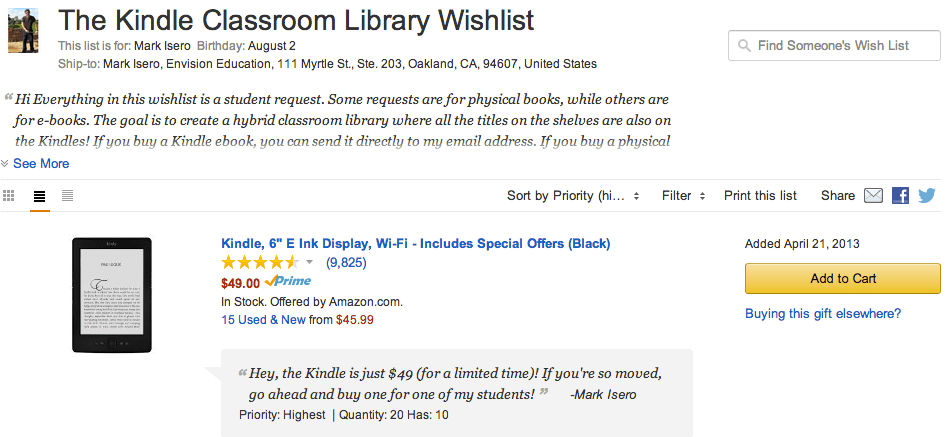
First, click here to go to my students’ Amazon wishlist. Then you’ll get this screen:

kindleamazon

Click “Add to Cart.” Then click “Proceed to Checkout.” At this point you might have to log in, and once you do, you’ll be directed to the shipping address page.

Good news: There is a “Gift Registry Address” already ready to be clicked. Click “Ship to this address.”

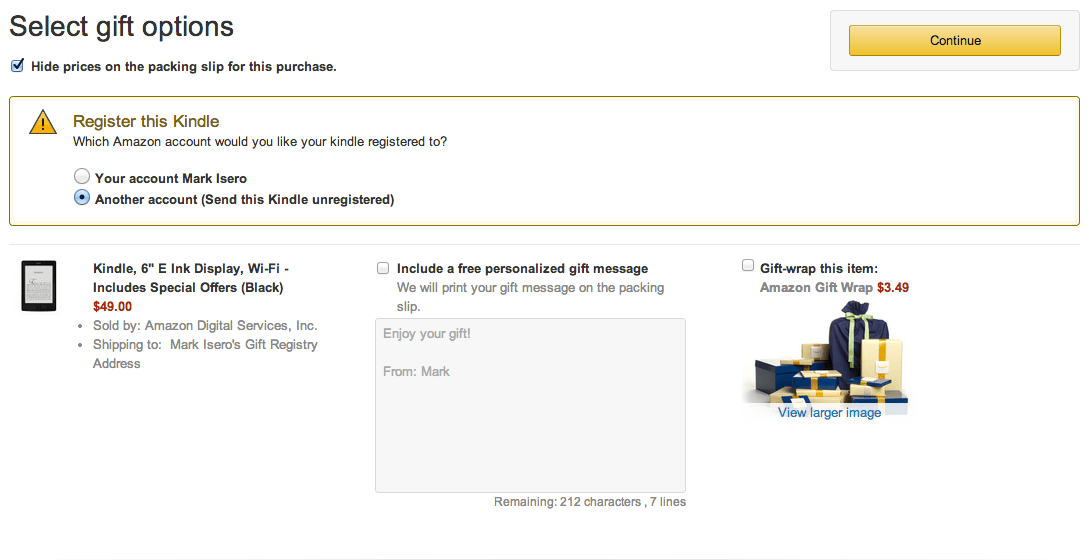
The next screen is a bit weird. It’s called, “Select gift options.” It looks like this:

giftoptions

Make sure to select that you’d like the Kindle to be registered to “another account,” not yours. And if you’d like, please include a free personalized gift message. My lucky student will be happy.

After that screen, you move into payment options, credit cards, and all the normal stuff when buying something online.

All right: Let’s see if this happens! If I write something up on Iserotope, and it goes out into the cyberspace, will loyal Iserotope readers take on this charge and either (a) make a Kindle donation, or (b) spread the word so that others will make a Kindle donation?

If you are in the (a) camp, please be extra bold and leave a BRILLIANT COMMENT confirming that you have accepted my challenge. It’s time that you’re proud of your contribution (unless you want to remain anonymous, of course, which is always an option)!

If you’re in the (b) camp, consider sharing this post. The easiest way is to select one of the social sharing buttons below. Thank you!

Update, May 1, 9:06 p.m. — We have liftoff! The wishlist says 1 Kindle has been purchased. Confirmation: That, indeed, is true. Thank you, Wil (New York, NY), for donating a Kindle! (It’s the second Kindle Wil has donated. Plus, he’s a sustaining contributor to the KCP.) Also, 6 people have shared the post so far. Thank you for getting the word out.

Update, May 3, 9:05 p.m. — It looks like two more Kindles have been purchased. But I don’t know (yet) who the donor is! Whoever you are, thank you!

Update, May 5, 8:43 a.m. — Oh no, the sale is over (for now). But the good news is, I received Wil’s Kindle and am awaiting the other two. Thank you again! favicon

Just a quick tweet…

Go ahead, follow me on Twitter! Or contribute to the Kindle Classroom Project! favicon

Get Your Students to Love the News, #2: Circa explains current events concisely

circanewsUpdate, Sept. 2014: This post is now out of date, thanks to circa’s 3.0 update, which is beautiful! But most of the post still stands.

favicon Yes, it makes me crazy that very few teachers emphasize current events. As a former social studies teacher, I can criticize my fellow social studies colleagues and ask, incredulously, “Um, how come you’re not having your students read the news?”

My modest proposal is that all English teachers should do independent fiction reading and that all social studies teachers should do independent nonfiction reading. Simple as that.

And that’s partly why I’m doing this Get Your Students to Love the News series. In case you didn’t catch the first installment (about Umano), I’m trying to suggest that it’s not all that hard or expensive to get your students excited about current events. You don’t need multiple subscriptions to newspapers or magazines. You don’t even need a computer. All you need is to convince your students to install an app on their phone.

That’s the case for Circa, an excellent phone app available for iOS and Android.

This is what the good people at Circa do. They identify the important news of the day. Then they read several articles from leading news sources, like the New York Times, the Washington Post, and the Wall Street Journal. And finally, in a stroke of genius, they incorporate the most important and common information from those articles into a succinct story that explains clearly what happened.

You could say that Circa summarizes the news, but David Cohn, the director of news, would disagree. I (sort of) see where he’s coming from. A straight-up summary wouldn’t necessarily give you the background and context of the news event. Circa does a good job there.

Also, a regular summary wouldn’t connect to you similar and related stories. A Circa story does. Best of all (my favorite), Circa stories include citations, so you and your students know from where the information is coming. Regular summaries don’t.

I like Circa for three main reasons: (1) It gets right to the point, and the reading level is moderate, (2) You can follow a Circa story, and when there is a new development, you can receive a notification, (3) The news is fairly serious. You won’t get articles about what your cat is trying to tell you when he knocks your valuables off the countertop.

Here’s a quick tour through a Circa story I read today — and why I think students would benefit:

Sample Title Page: Image, Headline, Lead

Screenshot_2014-04-29-17-50-40

Nice and simple. Your students will like the image, and they can get a quick glimpse of the most crucial facts. You could also ask them, before moving on, to set a purpose for reading the article, or to ask possible questions.

 Sample Body Page: Key Facts, Key Quotations

Screenshot_2014-04-29-17-50-47

This is a great example of how Circa identifies the key players, explains who they are, and lets them share their opinion. Therefore, students can build their background knowledge and also be introduced to important newsmakers. There’s nothing wrong, for example, with knowing who Justice Elena Kagan is and what she thinks about search and seizure.

Sample Explanation Page, Plus a Related Storyline

Screenshot_2014-04-29-17-51-06


Many news articles, because they build from assumed common background knowledge, and because they follow an incrementalist approach (day-by-day reporting), don’t always pause to make sure you know the basics. My feeling is that students would appreciate simple declarative sentences on this screen. Also, if they’re interested, they can read a related story (and follow it, too, if they like).

Sample Citations Page

Screenshot_2014-04-29-17-51-45

OK, so maybe this won’t be your students’ favorite page, but I think it’s excellent. It tells students, “Um, this is where we got the information,” and “News comes from news sources, and here are some of the most popular and most prestigious” (except for maybe USA Today). It’s a bit like checking a works cited page or a list of endnotes. I like it.

The only negative to Circa is that the writing may come off as dry to some students. After all, Circa is trying to remain objective. There’s not an easily discernible slant. There’s no edge. As a result, students may find the writing a bit boring.

My response to that possible criticism is that I believe it’s important that students are informed first before making a claim. Let’s teach them to gather information, to read a lot, to see different views — and then to make an argument.

If that happened, maybe our world would be a better place, too.

Please try out Circa and let me know what you think. If you try it out with students, I’d love to hear what they think. Thank you very much! (Feel free to make a brilliant insight.) favicon

Get Your Students to Love the News, #1: Umano caters to those who like to listen

umanofavicon I love current events, and newspapers make me happy, and I spend a lot of time reading nonfiction articles online. (Maybe too much sometimes.) It’s super important that we encourage our students to love the news, too.

That’s why I’m starting a new series, Get Your Students to Love the News. My hope is to share some of my favorite apps and websites to encourage teachers to motivate students to love current events.

First up is Umano, which I think is perfect for students, particularly reluctant readers. Umano reads you the news with real people narrating.

Can you believe it? I know, it’s crazy. The voices are not Siri or Cortana (or whatever Amazon calls its robot on Kindle), but real human beings.

Want to try it out? Here’s “A Cube with a Twist,” a New York Times article about the Rubik’s Cube, narrated by Larry Anderson. (Mr. Anderson’s voice is nice and smooth, don’t you think?)

And how about this embedded Umano player? (This article is anti-BART — but very pro-Umano.)

The website is nice, but the real magic comes on the mobile app, available on iOS and Android. It’s beautiful and powerful. (Besides, students are always close to their phones. A good phone app goes a long way.)

Here are just a few things students can do on the Umano mobile app:

1. Create “playlists.” When you open the app, you get a list of recommended articles. You can listen to them immediately, or better yet, save them to a playlist for later. That means that students can save up enough articles for the bus ride home after school (if they get bored listening to music).

2. Follow “channels.” Channels are topics of interest (like sports) or publications (like NPR). You can tell your students to sign up for a combination of interests and news sources.

3. Read articles while listening. This is a feature I really like. (I’m not one of those people who argue that listening is exactly the same as reading.) Once you’re listening to an article, you can press a “books” icon on the top to display the text. That means students can read along while they listen.

4. Submit articles for narration. Like most things in life, Umano right now serves a mostly adult audience. But there’s an option to request articles for narration. If enough of your students submit the same article, I’m hopeful that Umano will listen.

Like everything, Umano isn’t perfect. Sometimes, my preferences is for “harder hitting” news. But that’s nothing new for me. Really, if I step back, I realize that if the point is to get our students hooked on reading current events, we can’t always start with article after article on tough topics like the Israel-Palestine conflict.

If you’re a teacher — or even if you’re not — give Umano a try, and then let me know what you think by leaving a Brilliant Insight. favicon