Another easy way to promote reading: Make public a list of who’s reading what

favicon Here’s another quick and easy idea to promote reading from the classroom of English teacher extraordinaire Tess Lantos at Impact Academy in Hayward.

Post what students are reading. Make it public. Make it big and put it up on a wall. Like this:

Status of the Class

Tess tracks what her students are reading in a Google spreadsheet. Then, she gets huge paper and prints it out. Simple — and very effective!

With this tracker, students can check out what they’ve read, what their peers have read, and which books are most popular. It also helps Tess recommend books to students and push them to new reading levels.

The tracker also highlights how students tend to read “the biggies,” particularly at the beginning of the year. If you’re a ninth grader, you’re reading John Green, Coe Booth, Allison van Diepen, James Dashner, Luis Rodriguez, Suzanne Collins, and Stanley Tookie Williams.

It’s always better to have more copies of popular titles than a classroom library with wide selection but little depth! favicon

Things are getting serious! The Kindle Classroom Project gets business cards.

favicon When you have a business card, you know you’re legit. Right?

Well, everyone, it’s time to bask in the Kindle Classroom Project’s legitimacy. Because of the generosity of Iris and Donovan (San Diego, CA), the KCP now has business cards.

And they look absolutely great!

Let’s take a look. Here’s the front:

2014-09-19 10.35.54

And here’s the back:

2014-09-19 10.36.28

I am very, very appreciative of the time, effort, and care that Donovan and Iris put into making these cards. They have been long-time supporters of the KCP, and their enthusiasm for the project never wanes. They’ve also pushed me to think bigger, which is sometimes hard for me.

It’s time that more people learn about the Kindle Classroom Project, and these business cards are a great way to get the word out.

Do you want one? Let me know in the comments!

(Advanced: See what happens if you scan that QR code!) favicon

Let’s make reading public. Here’s one way.

favicon There are many teachers out there building independent reading programs, encouraging their students to read, raising money to buy books, and recommending good books to their students.

With all that going on, there’s not very much time left for teachers to invest in one crucial step: making reading public.

Too often, all that reading goodness is cooped up in classrooms. Students talk about their books to their classmates but keep things quiet with their friends. Teachers glow when Danny reads his 10th book of the year but dare not share that accomplishment with colleagues.

This reading bashfulness needs to change. It’s time for a reading revolution. The public needs to know that teenagers like to read. Let’s make this happen!

Take a look at what Math teacher Brandon Barrette is doing with his advisees at City Arts and Technology High School in San Francisco. Here’s what’s outside his classroom:

Sure, this takes dedication and effort, even with Mr. Barrette’s snappy template. But over time, book reviews will line the hallway, and students will take notice, get ideas about what to read next, and see their friends taking on academic identities.

In schools, what’s public is what matters. That’s why I’m happy to see Mr. Barrette taking part in his school’s reading revolution. favicon

Recommended Reading: “Read Slowly to Benefit Your Brain and Cut Stress”

favicon There are more and more articles about the therapeutic value of reading. I think these articles have merit. My gut says that schools with reading cultures also promote mindfulness and empathy in students.

In “Read Slowly to Benefit Your Brain and Cut Stress,” Jeanne Whalen reports on a “slow reading movement” that is growing among adults. Instead of book clubs that discuss books that are read at home, more people are joining book clubs where silent communal reading is the goal.

There’s the controversy, of course, about whether e-readers are allowed. Ms. Whalen does a good job of distinguishing between distraction-prone devices (like tablets with wifi) vs. E Ink devices, where reading is the norm.

Excerpt
“Once a week, members of a Wellington, New Zealand, book club arrive at a cafe, grab a drink and shut off their cellphones. Then they sink into cozy chairs and read in silence for an hour.”

Source: http://j.mp/1meeeLM (via Pocket). You can also find this article at Iserotope Extras, a curated list of my favorite articles about teaching, reading, and technology. favicon

It’s pretty simple: My quick vision for the Kindle Classroom Project

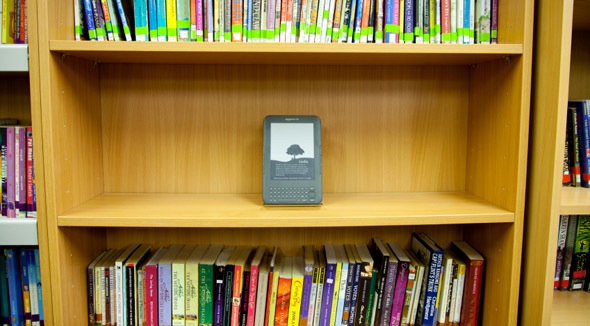
Kindle Libraryfavicon People have been asking me how I’d like the Kindle Classroom Project to grow. It’s pretty simple, I think. Here it is:

1. You’re a new ninth grader. You get a Kindle.

2. Your school has a beautiful physical library of excellent books, ones you want to read. The books have outward-facing covers. You browse the shelves, and when you want to read a book, you search for it on your Kindle, and it’s there.

3. If you want to read a book that’s not in the library, you request the title, and it’s bought for you. The book appears on your Kindle, and a physical copy of the book arrives soon in the physical library.

4. Your teachers care about reading. They give you some time to read in school, and they encourage you to read outside of school, too. They read themselves. They recommend books to you, and they care about your reading life.

5. You come to enjoy reading and make it a part of your life. Some years, you read 10 or 20 books. Other years, you read 40 or 50. You keep track of the books you’ve read and recommend your favorites to your friends.

6. When you graduate, you get to keep your Kindle. By then, you’ve signed up for your own Amazon account, and you know how to get e-books from your public library. You’ve become an independent reader. favicon