Good friends are great, and so are generous donors. Tony (W. Hartford, CT) is both. Thanks, @tjohnston819, for giving to the #KCP!
— Mark Isero (@iserotope) April 27, 2015
Go ahead, follow me on Twitter! Or contribute to the KCP! 
Good friends are great, and so are generous donors. Tony (W. Hartford, CT) is both. Thanks, @tjohnston819, for giving to the #KCP!
— Mark Isero (@iserotope) April 27, 2015
Go ahead, follow me on Twitter! Or contribute to the KCP!
Kindle donors are not just generous. They’re also creative and conscientious. You can tell in the packaging.
Today, Kindle #513 came, a Kindle Fire from Jules in Portland, Oregon. Thank you, Jules!
Here’s the outside of the package. Note the drawing.

And here’s the inside of the package. Yep, it’s another padded envelope, just in case, plus another note.

And take a look at the little notebook that Jules included. Though I want to keep this notebook, I’ll be giving it to the student who gets Jules’s Kindle.

The extra touches are perfect. I can’t wait to give this Kindle away to a student. He or she will hear about Jules from Portland who packages her Kindle safely and securely and who really cares about the student’s reading life.
Want to read more stories like this? Subscribe to the new monthly Kindle Classroom Project Newsletter!
Ed. Note: The following book review is by Noam O., a student in Kathleen’s class in San Francisco.
 The Glass Cage is a neutral book about the pros and cons of technology and automation. I enjoyed it because I expected the book to be biased against technology, and I expected it to speak of the evils of modern technology. Instead, I was pleasantly surprised by the author’s neutrality and his ability to weigh the pros and the cons of technology and automation. It talks about how technology has been incredibly helpful and is the hallmark of our species. At the same time, the book also speaks of the dangers of its misuse and how we must balance the use of technology.
You don’t need a master’s degree in Statistics to understand this graph:
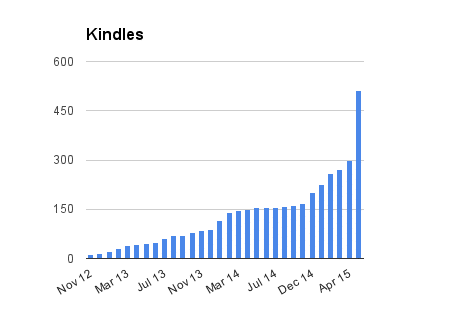
The growth of the Kindle Classroom Project is startling. It took 18 months for the program to reach 150 Kindles. For the next 150 Kindles, it took less time, just 11 months.
And then things went boom. In the last three weeks, the number of Kindles has skyrocketed from 300 to 512.
Most of the growth came from last week’s gift of 210 Kindles from a generous donor who would like to remain anonymous. Still, Kindles continue to stream in from people across the country — usually one at a time, but sometimes in multiples — and there is no sign there’s anything stopping this glut.
Which is all pretty great. More students are reading, more teachers are feeling supported, and what was once a cute little hobby of mine is entering a new phase in its development.

That next phase is going to be exciting. Hundreds of students from several high schools in Oakland and San Francisco are going to be reading books from the Kindle Library, taking their Kindles home, writing reviews, and talking about the books they’ve read. In short, the scale of the project has shifted.
The greatest challenge of this next phase — and greatest opportunity — is making sure the 500+ students have all the books they want to read when they want to read them.
That’s why it’s my goal to raise $5,000 by September 1.
That figure, I predict, will support the 500+ students and their reading lives through the end of the 2015-16 school year. The money will go to build the Kindle Library, to purchase additional copies of popular books, and to honor student requests of new books.
Would you like to help?
You can make a donation via PayPal (using your PayPal account or credit card), via Square (using your debit card), or via an Amazon gift card (to the email kindleclassroomproject at gmail dot com).
Or, if you’re advanced, you can become a sustaining donor by making recurring monthly donations. Choose a level (Book Lover, Bibliophile, Bibliomaniac, Bookworm) that feels comfortable to you.
Ed. Note: The following book review is by Nicholas G., a student in Kathleen’s class in San Francisco.
 Crank, by Ellen Hopkins, was one of the most interesting fiction books I’ve read in a long time. The writing style author Ellen Hopkins employs is odd, yet it provides for a much more entertaining read. It is almost like reading a poem, yet it still is very unique.
The story tells of a girl and her downfall into the depths of drug addiction. I would recommend this book for someone looking for an unusual but quick read. Since the pages are like a poem with unorganized stanzas, it actually doesn’t take too long to get through this book.