Let students read what they want

favicon Common Core is here, which many say is the death knell of independent reading. Teachers are worried that they’ll have to throw away their classroom libraries. Close reading of short texts, they say, will replace full-length novels.

I say that it doesn’t have to be this way — that it’s not an either-or.

If Common Core succeeds, then reading will spread across the curriculum. Science, social studies, and Math teachers will include more informational text in their classes. It might be true that English teachers will introduce more short nonfiction. But if that is done well, there will still be room for students to read what they want.

Especially at the ninth grade, and especially with students who haven’t read a book for years, we must encourage our students to be readers. That’s not going to happen exclusively with short, nonfiction, teacher-assigned texts. No ninth grader is going to become a voracious reader after his teacher assigns him The Gettysburg Address (though it’s a nice speech).

That’s why I think English teachers should not rebel against Common Core (there’s nothing wrong with the new standards) but rather make sure to preserve independent reading as a major component of their curriculum. At some schools, this might take some creativity — like shifting independent reading from English class to Advisory — but it can and needs to be done.

In my experience, interest in reading, or lack thereof, among ninth graders is pretty absolute. If students get to choose what they read, they love it. If they don’t, then they don’t. Simple as that.

So what’s wrong with letting students, as part of their school experience, to read what they want?

Here are a few books that I recently got from a DonorsChoose grant. They’re among the most popular titles, particularly for my Latina/o students. I’m a huge fan of A Place to Stand and My Bloody Life. They’re well written. Boys get in line to read them.

2013-03-25 09.34.48
Yes, maybe not every book is of high literary quality (e.g., the Amigas series). But if students are reading 20-40 books a year, there’s nothing wrong with a fun and easy pick sometimes. It builds speed and fluency and stamina, not to mention a joy of reading.

I may be in the minority here. Some may say that independent reading lacks academic rigor, that if I let my students read Perfect Chemistry, they’ll never read The Great Gatsby. I say exactly the opposite: If I don’t let my students read Perfect Chemistry, they’ll never read The Great Gatsby.

What do you think? favicon
The risk of going to college

favicon A few years back, something switched.

Up until then, my students — many of whom were the first in their families to go to college — would enter senior year aspiring to get accepted into a four-year university. They would complete applications, write personal statements, look for scholarships, and fill out financial aid forms. In the Spring, many students would receive good news from UC Santa Barbara or San Jose State or Dominican University. And that was that.

In short, my students believed, as The Atlantic reported today, that “going to college is perhaps the single best financial decision a young adult can make.” Even if college meant a little (or a lot of) debt, getting a four-year degree was the right thing to do.

This is no longer always the case.

With college tuition rising, particularly at state public schools, many of my advisees began openly questioning the value of college. The military became a popular option; three of my 2012 graduates, including the school’s valedictorian, joined the armed forces. (The valedictorian quickly dropped out of the Naval Academy and will attend UC Davis in the Fall.) Others eligible for San Francisco State chose City College instead. A few decided to find a job immediately.

Part of the trend, of course, is based on economics. After all, why wait to make money when you can start making money now? With the unemployment rate fairly high, even for college graduates, that line of thinking makes sense. Better maybe to pursue a two-year technical degree to prepare for a medium-skilled career as an X Ray technician. Four years is a long time for an 18-year-old who just spent an eternity (of the same length) in high school.

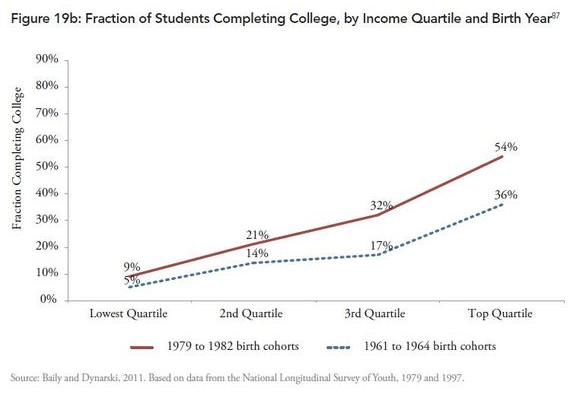
Like many teachers, I shun that perspective and believe that college should be the goal for all students. But The Atlantic article included a graph that put things into perspective, that really demonstrated how much of a risk going to college is, particularly if you’re not wealthy.

MI

Is this what my students have been telling me — that if they’re not completely sure they’ll graduate, that if they lack confidence in their academic skills, that if they think college might be too much for them, then maybe they shouldn’t take the financial risk?

For many people, a graph like that may lead to the conclusion that maybe college is not meant for everyone. I usually hear it like this: “Is it right for us to tell them that the only way to achieve happiness is by earning a bachelor’s degree? I mean, what if they don’t graduate and are saddled with debt?”

Here’s a corollary: “Just because I have a college degree, is it my place to demand it of someone else?”

The answer to both of those questions is undeniably yes — despite all the risks. But The Atlantic article also reminds us that we must provide our students, particularly our first-generation college students, a full understanding of what college looks like, of what it entails. favicon

Two easy ways to promote independent reading

favicon Here’s a book stand that I found at one of my schools. You’ll notice that the books are really old. (I’m not sure that students will snatch up The Best American Short Stories of 1984.)

But the stand itself is pretty great. And it demonstrates what booksellers and librarians have known for years: People prefer books when their covers are facing outward.

This leads me to two quick ideas:
1. Display “just read” books. When students finish their book, they don’t immediately shelve the book back into the classroom library. This lowers the chance of a book getting popular. Rather, students put their book on the just read stand. Thisshows other students which books have just been completed, which can increase circulation.

2. Display “our favorite” books. After a book is read by, say, five students, it’s eligible for placement in this bookstand. The goal is to build a display of the students’ most-loved books of the year. A few questions: What happens when the stand is fulland there’s another nomination? Does one book have to be voted off the stand? Also, I assume these best-books will be popular. Does there need to be a placeholder to stand in for that book when a student is reading it?

I can’t wait to get this stand into a teacher’s classroom. My hope is to take another photo once students make the stand their own. Let me know what you think and if you have other ideas for displaying books. favicon

No, Google Keep is not (yet) an Evernote killer

favicon Today, Google launched Google Keep, which lets you take notes and remember things that are on our mind. Here’s a quick video.

From your phone, you can take notes, create to-do lists, snap pictures, and record audio, all of which is saved and organized in Google Drive. It’s pretty simple and fun to use. There are colors to choose from! There are icons to press!

Because of its simplicity, I can see why people might like Keep, especially if they don’t yet use a notetaking or to-do app. In fact, I can see Google Keep syncing with or replacing Google Tasks. Right now, you can’t see Keep items (your Kept items? your Keeped items?) on your Google Calendar or in your Gmail. Maybe that will happen in the future.

Some people are saying that Google Keep is an Evernote killer. (Yes, the product has been out for just a few hours.) At least in Keep’s initial form, this is not going to happen. Right now, Keep looks pretty small and underwhelming. It’s a place where you might write down some thoughts and save them for a short period of time. It’s not where you’d archive your receipts and invoices.

Most telling, Keep doesn’t let you clip snippets or save articles from the Internet. Until Google creates a web clipper that saves online content on Drive, Evernote will still be the best option for people who like to organize different types of content all in one place.

So what do you think? Is Keep something you’ll try out? favicon

Another Kindle donated

favicon This just in: Today, after several weeks of slow Kindle contributions, I got a Kindle Keyboard in the mail. This is the 42nd Kindle. More details to come soon!

Update: I don’t yet know who donated this device, but I hope to find out soon. Thank you, Someone from Minnesota! favicon