Building our Kindle library, book by book

favicon The Kindle Classroom Project is only as good as the quality of its books.

Sure, I love getting Kindles in the mail from generous donors. It’s crazy to think that at this time last year, there were 12 Kindles in the collection, and now there are 80. I’m very appreciative!

But without books that my students want to read, those Kindles would go unread. That’s why I’m putting in more effort and resources into building the Kindle library. Right now, the library stands at 289 titles, and I’d like to reach 350 by January.

Like any good librarian, though, I’m not just accumulating books willy-nilly. After all, it would be easy to download tons of free classics from Project Gutenberg. But a bursting library with thousands of titles may overwhelm students new to Kindles and unfamiliar with vast collections.

The correct approach to building the Kindle Library involves four steps:

1. Ask students to request books they want.
There’s something powerful when a student approaches me, requests a book, and then I get it for them quickly, sometimes even right then in the moment. It says, “I’m listening to you, and I care about your reading, and you should be able to read what you want to read as soon as possible.”

Because of generous donors, I have an Amazon gift card balance ready for student book requests. My rule is that students can’t request a new book until they complete at least one from the library. After that, though, I’m happy to buy books for students. I’ve found that students choose well, plus requested titles often get read by multiple students at the same time.

If you’d like to help students read books they request, send me an Amazon gift card! My email is iseroma AT rocketmail DOT com. If you’d rather donate cash, go to my WePay Donations page!

2. Scour bookstores and other classroom libraries for good titles.
Whenever I go to Barnes and Noble or another rare real-life bookstore, I head over to the Young Adult section to check out the new titles. Many of them don’t fit my students, but it’s good to see what’s out there.

I’ve also had a lot of success asking other ninth grade teachers and teacher librarians. If there’s a book that you know my students would love, and it’s not in the current Kindle library, please email me or leave suggestions in the comments.

3. Acquire books that mirror the physical classroom library.
I’m happy right now with the 289 titles in the Kindle library, but that’s no match for the 688 books in my physical classroom library, which is currently on loan in Berkeley. Want to see it? Here’s a picture from last month (there are more books now). Nancy Jo Turner is masterful.

Isn't it amazing?

The problem is, Many of those great books in the physical library aren’t mirrored on the Kindles. In fact, I just completed a detailed analysis that concluded that fewer than 100 titles in my physical library are part of the Kindle library.

I have to do better. Classroom library mirroring is important. No, not all physical books should be mirrored, but many should be. If you’d like to help out, visit my Amazon wishlist, where I’m adding titles that need mirroring. Just be sure to add your name in the optional message box so that I can thank you (unless you want to remain anonymous).

4. Get rid of titles that never get read.
Here’s the controversial one. All good librarians weed books that circulate poorly. It’s an important part of sound collection management. But people are weird about books. They think you’re doing something sacrilegious if you donate or recycle a tattered book that nobody has read since 1931.

The sentiment is even stronger with Kindle books. “Why would you get rid of an ebook?” Over the years, I’ve found that students are bored by libraries that seem overgrown. The quality of each title matters much more than the quantity of total books. It’s much better to have 200 great books than 1,000 not-so-great ones. So that’s why I weed.

But here’s the best part of a Kindle library: You can weed and still keep the books, just in case, for later. Because they take up no physical space, I can easily take ebooks off the Kindles and keep them, safe and sound, on my computer. They’re always ready in case a student requests the title or if I change my mind.

* * *

There you have it! Thanks for reading about my plans to build the Kindle library. If you’d like to help out, please do. Let me know your thoughts. Also, you can head over to the Contribute page for more details about the 7 ways you can support students and their reading lives. favicon

Do poor students need homework?

favicon There was a provocative piece in The Atlantic this week, “Poor Students Need Homework,” in which Robert Pondiscio, a former fifth grade teacher, argues that it’s not appropriate for affluent parents to dominate the debate about the value of homework.

Just because rich kids do well regardless of their homework load, that doesn’t mean the same thing is true for poor kids, Mr. Pondiscio contends.

[E]ducation “best practices,” fads, and trends tend to roll downhill from what ostensibly works in well-funded, affluent schools to those serving low-income kids of color.  After all, if it’s what the best and wisest parent wants, it must be good for all children, right? Not necessarily.

homeworkMr. Pondiscio’s piece reminds me of last year’s big French homework debate (there are always big debates in France), which pitted President Francois Hollande, who wanted to get rid of homework, against working class parents, who wanted more homework.

Over the past few years, I’ve written a bit about homework, and it’s pretty clear that I go back and forth on the topic. On the one hand, I’ve argued that students benefit from additional learning opportunities, and one hour a day of reading and writing in class just isn’t enough to close the achievement gap.

On the other hand, I’ve sometimes had my doubts. Is homework just an antiquated remnant from the factory model geared to force compliance and quash creativity? Alfie Kohn may not convince me on the perils of homework, but teachers who have abandoned homework and maintained good results sometimes do.

So where do I stand now? Well, one thing is true: I do agree with Mr. Pondiscio that rich parents, particularly those far away from the realities of urban public schools, shouldn’t be able to dictate what they want. Decisions about poor kids of color should come from the students’ parents, teachers, and local community.

In my experience, very few parents have told me that homework is a bad idea. To them, homework has meant hard work, and hard work has meant college, a dream come true. To those parents, even if students don’t complete their homework — which is very common, particularly among ninth graders of color in urban public schools — homework means rigor and a path to success.

Besides, a low homework completion rate is not an argument to get rid of homework. If you’re a teacher assigning homework and your students aren’t doing it, that’s your problem to solve, not theirs. The easy answers — to blame the students, to blame the parents, or to abolish homework altogether — don’t seem right, either.

Then again, just because homework has been a consistent component of the college-prep school experience does not mean that it should continue. And there’s nothing good about three hours of homework if it’s not worthwhile. As Mr. Pondiscio suggests, less homework and more independent reading might be the answer.

Wow, I’m confusing myself! Oh, how to get through this mess? There’s a lot going on here. I encourage you to read Mr. Pondisicio’s article and let me know your thoughts.

Coming up soon: A veteran teacher who no longer assigns homework and thinks it’s the best decision she’s ever made. favicon

Great new Kindle cover from Mary in Iowa!

favicon Mary from Iowa has struck again! Today, she donated three more e-books: It Calls You BackThe Willpower Instinct, and Fire in the Ashes. All three titles were student requests on the Kindle Classroom Project Wishlist. (Check it out!)

In addition to those donations, Mary also sent a beautiful cover for the Project’s first-ever Kindle Paperwhite. Take a look! First, the front.

image

Don’t you love the color? On Amazon, it’s called “persimmon.” It’s perfect. What’s even better (than perfect? you ask) is what happens when you open the cover. The Kindle automatically turns on, like an iPad, and is ready to read.

image

I’m thoroughly impressed and incredibly grateful. Mary is just one of the generous donors who care about my students and their reading lives. I’m particularly appreciative of people who are repeat donors. You make the program grow and stay sustainable. favicon

Iserotope Extra: “Why Reading Sucks and It’s OK”

favicon Pernille Ripp is an elementary school teacher who believes in independent reading and is not afraid to tell the truth to her students. That’s also partly why her blog is so popular among educators.

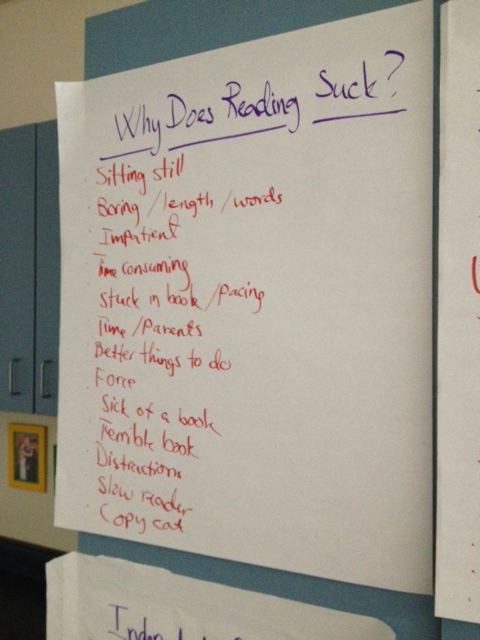
In a recent post, “Why Reading Sucks and It’s Ok to Talk About It,” Ms. Ripp talks about what she did recently when a student shared that reading sucked. Instead of disagreeing with the student, she affirmed the student’s (current) feelings and even opened up a brainstorming session about all the possible reasons that reading might indeed suck. Here’s her chart:

It’s a pretty good list, don’t you think? (It’s particularly interesting to me how many reasons are connected to feelings of inferiority or stigma related to reading.)

It makes me happy that Ms. Ripp didn’t cower or get too teachery. Sometimes, I’ve felt like I have to offer a counter-narrative, something like, “Oh no! You can’t mean that! Reading is great! What you just said is a big fat lie!” That’s not quite right because it doesn’t validate the student’s opinion, what the student just said.

On the other hand, I’ve also been prone to affirm the student’s response almost too energetically, as if it’s really really OK to say that reading sucks. “Yes, I am so happy that you said that! You are right on the mark, Johnny. In fact, boys and girls, if you liked reading before Johnny just spoke, you should listen to Johnny because he’s cool and you want to be, too!” This approach doesn’t work, either.

Ms. Ripp’s response — which I think was to consider the student’s feelings matter of factly (but not too excitedly), to be honest that sometimes reading does suck (especially when there’s no choice involved), and to use the remark an opportunity to move through a common reaction to reading — seems perfect.

What do you think? Please go ahead and read her post (see below) and then let me know your thoughts.

Source: http://pernillesripp.com/2013/09/14/why-reading-sucks-and-its-ok-to-talk-about-it/ favicon

Book Review: Quiet (★★★☆)

QuietCoverfavicon People have told me that I’m an introvert, and so have a few Myers Briggs tests, but reading Quiet: The Power of Introverts in a World That Can’t Stop Talking confirmed it. I’m sure I had a similar reaction to Quiet as did other introverts — something like: I’m not a complete freak. And that’s why I really enjoyed the book.

Plus, Ms. Cain writes really well. I didn’t like all the chapters equally — for example, the one on relationships was very interesting, whereas the one on raising kids was not as much — but overall, the book kept my attention and offered a new way of being in the world. Its message, in short, was, Everything is OK.

At points, however, I felt like Ms. Cain (introverted herself) was trying to argue that introverts are smarter and kinder and better people who have more empathy. Whenever she’d go a little too much in this direction, though, she made sure to reel her judgment back in to a more objective stance.

Another way to think about this book: It’s definitely somewhere in the newish nonfiction genre, popularized by Malcolm Gladwell, of self-help-with-a-little-science, but Ms. Cain’s tone wasn’t as matter-of-fact annoying, not as too-sure. I liked that a lot. favicon